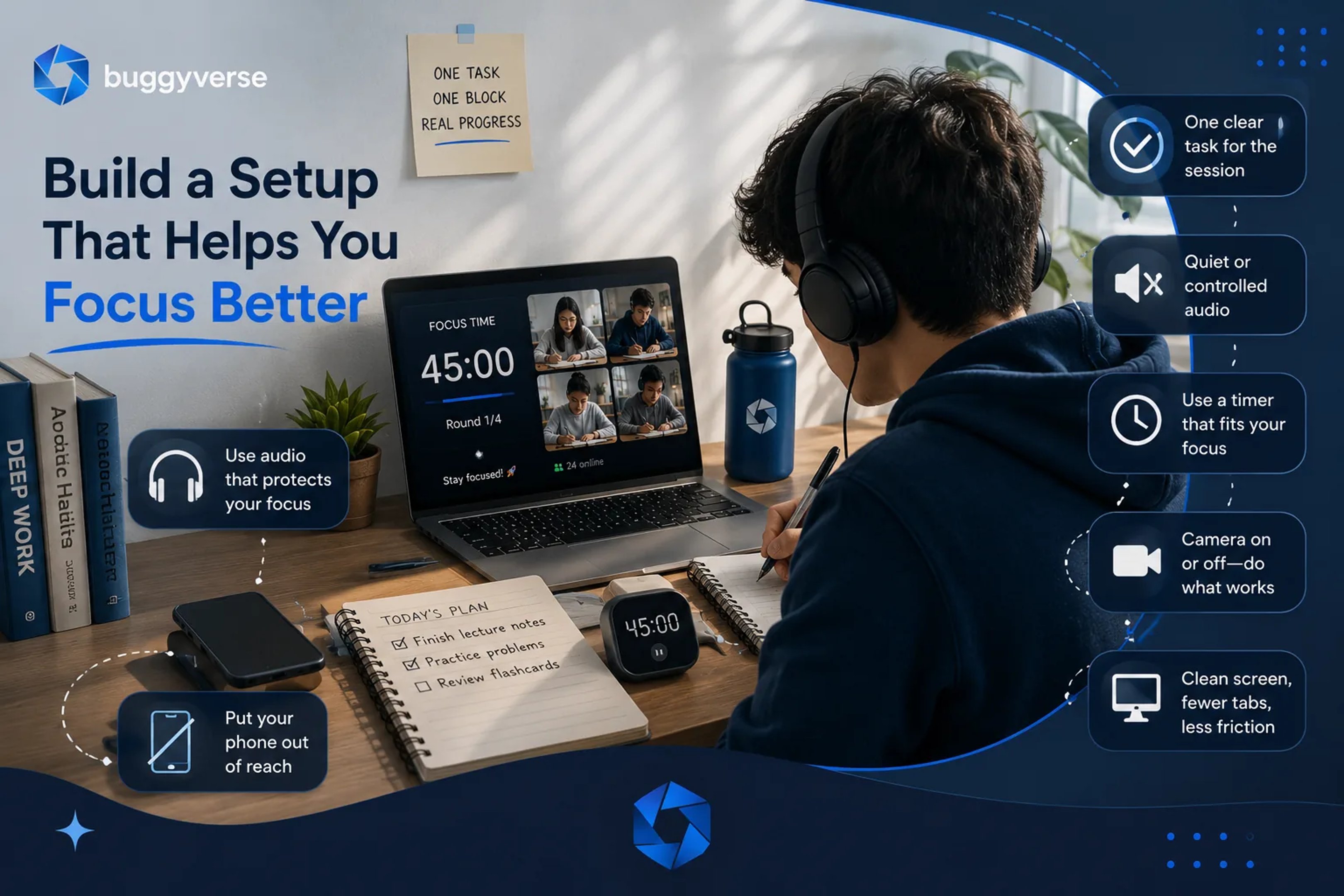
If you like the idea of studying with other people but hate chaotic group sessions, group Pomodoro can work well. The structure is simple: everyone focuses for a set block of time, takes a short break, and repeats. The hard part is not the timer. It is running the session in a way that helps people actually stay on task instead of turning the room into background noise.
A good group Pomodoro session should feel clear, quiet, and predictable. People should know when to work, when to talk, and what kind of room they are joining. If those expectations are fuzzy, the timer starts to mean less and the session usually drifts.
What group Pomodoro is actually good for
Group Pomodoro works best when people need help starting, staying in their chair, and getting through work that feels mentally heavy but not impossible. It is especially useful for solo study that feels isolating, long reading or writing blocks, assignment catch-up, exam prep that benefits from steady repetition, and body doubling without a lot of conversation.
It is less useful when the work requires uninterrupted deep focus for several hours, or when the group wants a social hangout more than a study structure. Some students do better with longer blocks than a classic 25/5 rhythm. That does not mean group Pomodoro is bad. It just means the format has to match the work.
Start with the right timer format
A lot of group Pomodoro sessions fail because the timer is too rigid or too random.
If the room is for general studying, these formats usually work well:
- 25/5 for people who struggle to start.
- 45/10 for reading, problem sets, and moderate focus work.
- 50/10 for more settled groups that do not need frequent resets.
If you are running the session for strangers, shorter explanation and clearer rhythm matter more than optimization. People join a room and decide very quickly whether they want to stay. A room with a visible timer and a consistent pattern is easier to trust than one that keeps changing every cycle.
Set the rules before the first focus block
You do not need a long speech. You do need a few clear expectations.
At minimum, people should know:
- whether cameras are expected, optional, or off by default;
- whether chat is for quick check-ins only or open during breaks;
- whether microphones stay muted;
- how long the focus and break blocks are;
- whether late joiners should wait quietly or jump in right away.
This matters more than people think. A student joining at 11:30 PM from a bedroom or dorm does not want to guess whether the room is silent, social, or weirdly intense. Clear rules remove that friction.
A simple opening works:
We are doing 50 minutes on, 10 minutes off. Camera is optional. Mic stays muted. Save chat for breaks unless you need a quick study check-in.
That is enough.
Keep the room quiet during focus time
The biggest mistake in group Pomodoro is letting the session become half study room, half casual chat. That usually helps nobody.
During focus blocks, keep interaction light. People should be able to glance at the room, feel the presence of others, and get back to work. If someone wants constant conversation, they probably need a coworking room with a more social format.
A short check-in at the start of a block can help:
- What are you working on this round?
- What is your one goal for the next 25 minutes?
Then the work starts.
Use breaks carefully
Breaks are where group Pomodoro either becomes motivating or falls apart.
A good break gives people a mental reset without fully pulling them out of study mode. That usually means standing up, stretching, getting water, or sending one short message in chat. A bad break turns into ten browser tabs, side conversations, or people disappearing for twenty minutes.
If you are hosting, keep breaks short and visible. Remind people when the next block starts. If the room has chat, break time is the safest moment for quick social energy. That is often enough to make the room feel human without derailing the session.
Make it easier for awkward or camera-shy students to join
Not everyone wants to study with a camera on. Some people are in shared apartments. Some are in bed with a laptop and headphones. Some just do not want to be watched while they work.
A well-run group Pomodoro room makes space for those people. Camera-optional rooms are often easier to join, especially for first-time users. The important part is not forcing one style. It is making the room's expectations obvious.
This is one reason platforms like Buggyverse can help. If someone wants a free study room with a timer, chat, and the option to join public or private rooms without treating camera use as mandatory, that setup lowers the barrier to starting.
Do not overload the session with productivity theater
You do not need complicated rituals to make group Pomodoro effective.
Most students are not looking for a performance. They are trying to open the assignment, stay off their phone, and get through the next block without spiraling. Overly dramatic accountability systems, long introductions, and constant motivational talk can make the room more tiring than the work itself.
What usually works better is:
- a visible timer;
- one clear rhythm;
- a quiet room;
- short break windows;
- low-pressure accountability.
That last part matters. A student who says, I need to finish two pages before the break is often more likely to do it when other people are there, even if nobody says much.
Common mistakes that ruin group Pomodoro
Changing the format every round
People settle in when they trust the rhythm. If the session keeps switching from 25/5 to 40/15 to open discussion, the room starts to feel random.
Treating breaks like social hour
A little conversation is fine. A break that completely resets everyone's attention is not.
Making the room too strict
Some hosts overcorrect and create a room that feels tense. If people are scared to join late, ask a question, or keep their camera off, the room becomes harder to use.
Ignoring different kinds of work
Not every task fits the same timer. A writing sprint, math practice block, and memorization session do not feel the same. Good hosts pick a format that matches the likely workload.
How to know if your group Pomodoro setup is working
A good session usually has a few signs:
- people stay for multiple rounds;
- the room does not need constant moderation;
- check-ins are short and useful;
- breaks do not swallow the session;
- people leave having actually finished something.
That is the point. Not perfect discipline. Real progress.
A practical way to start
If you want to run group Pomodoro without overthinking it, start with this:
- use 50/10 or 25/5;
- make camera optional;
- keep mics muted;
- allow chat mainly during breaks;
- ask each person for one goal at the start of the round;
- run three or four cycles before changing anything.
Then pay attention to what the room feels like. If people keep drifting, shorten the focus block. If everyone seems interrupted by breaks, lengthen it. If the room feels dead, use a little more structure at the start of each round instead of more talking during work time.
Group Pomodoro works when it reduces friction, not when it adds another system to manage. If you want that kind of structure with real people around you, join a free study room on Buggyverse and try a session that matches how you actually study.