
# How to Start a Campus Study Ambassador Program Without Burning Out If you have ever wished your campus had a better study culture, you are not alone. A lot of students want more accountability, more structure, and more people to study with. The problem is that most student-led programs start with energy and then fade out once midterms, club meetings, and life pile up. A campus study ambassador program can work, but only if it is simple enough to survive a real semester. This guide is for students who want to start one, join one, or suggest one to a club, library team, class group, or student success office. The goal is not to create a giant leadership machine. The goal is to help students focus more often, with less friction. ## What is a campus study ambassador program? A campus study ambassador program is a small peer-led system where students help other students build better study habits. An ambassador is not a tutor in every subject. They do not need to be the smartest person in the room. Their job is usually much simpler: - host or co-host study sessions - help new students feel comfortable joining - model basic focus habits - keep the session structure clear - encourage consistency without turning the space into a pressure cooker Think of it as peer accountability plus community rhythm. ## Why students actually join programs like this Most students do not join because they want another extracurricular title. They join because they want one of these outcomes: - a reason to show up and start - a quieter alternative to chaotic group chats - a study routine that feels less lonely - a way to recover after procrastination spirals - a simple structure during exam weeks That means a good ambassador program should solve a student problem first. The title, branding, and leadership ladder come second. ## Start with one small promise The easiest mistake is trying to launch a huge campus initiative too early. Start with one small promise, such as: - "We host two quiet focus sessions every week." - "We run a 90-minute exam prep room on Sunday nights." - "We help new students find a study routine in their first month." A small promise is easier to repeat. Repetition matters more than hype. ## Pick the simplest format possible If your program is hard to explain, students will not remember it. A strong beginner format looks like this: 1. Students join a study room or focus session. 2. Everyone shares one goal for the block. 3. The room works quietly for 25 to 50 minutes. 4. There is a short break. 5. Students either leave or repeat one more round. That is enough. You do not need a long speech, icebreakers, or a complicated points system on day one. Students usually come for structure, not performance. ## Choose ambassadors based on reliability, not charisma The best ambassadors are not always the loudest people in the club. Look for students who: - show up on time - can explain things simply - make others feel welcome - respect quiet focus time - stay calm when turnout is low A reliable ambassador who can host eight useful sessions is more valuable than a charismatic ambassador who disappears after week two. ## Give ambassadors a short script Many student leaders burn out because they think they need to improvise everything. Do the opposite. Give ambassadors a short repeatable script. Example opening: "Welcome in. Drop your goal for this block in the chat or say it out loud. We are doing 30 minutes of focus, a 5 minute break, and then one more round if you want to stay." Example break reset: "Take a quick break, stretch, get water, and come back with your next target. Keep it small and specific." Example closing: "Before you leave, note what you finished and what you want to start next time." A script reduces pressure. It also makes the experience more consistent for everyone. ## Keep the role small enough to survive midterms If the ambassador role becomes too big, students will quit. A healthy role usually means: - hosting one or two sessions per week - replying to basic questions - sharing the session link or location - encouraging respectful norms - escalating real problems to a staff member, club officer, or lead organizer A bad role usually means trying to mentor everyone, manage conflict alone, track endless metrics, and stay available all day. When in doubt, shrink the role. ## Create rules that protect focus Students often say they want community, but what they actually need in a study session is predictable calm. Good baseline rules include: - show up with a specific task - keep side conversations short - use breaks for socializing instead of the middle of the block - respect camera-on and camera-off preferences if the session is online - do not shame people for small setbacks or imperfect progress The best rules are easy to remember and easy to enforce. ## Make it easy for new students to join late A lot of student programs accidentally become insider circles. Prevent that by making it normal for someone to join in week four, miss a week, and come back again. You can do that by: - repeating the same session structure every time - posting the schedule in one obvious place - avoiding too much private jargon - letting new people observe before they talk - pairing first-timers with a friendly host or returning member A program grows when students feel they can join without needing a perfect start. ## Use simple metrics that actually matter You do not need a giant dashboard to know whether the program is helping. Start with questions like: - Are students coming back next week? - Are sessions starting on time? - Do students leave with a clearer plan than they had before? - Are ambassadors still able to keep up without resentment? If you want one useful metric, track repeat attendance. A program that students return to is usually solving a real problem. ## Watch for the common failure modes Most campus study ambassador programs struggle for predictable reasons. ### 1. The program is too vague If students do not know whether it is a tutoring group, accountability room, social club, or productivity challenge, they hesitate to join. Fix: define the session clearly in one sentence. ### 2. The leaders are doing too much If one or two people carry the entire system, burnout comes fast. Fix: reduce the role, rotate responsibilities, and keep the format simple. ### 3. The sessions feel awkward Too much forced interaction can scare off students who mainly want help getting started. Fix: let the structure do the work. A clear timer and goal check-in are often enough. ### 4. There is no rhythm Random sessions are easy to forget. Fix: keep the same days and times whenever possible. ### 5. The program turns into pressure Students already deal with enough guilt around studying. Fix: focus on consistency, not intensity. Missing one session should not feel like failure. ## A realistic first-month plan If you want to launch this on your campus, here is a realistic version: ### Week 1 - choose one format - recruit one or two reliable ambassadors - set two recurring session times ### Week 2 - run the first sessions even if turnout is small - ask attendees what made it easier or harder to focus - keep notes on what felt confusing ### Week 3 - repeat the same structure - improve the reminders and join instructions - invite returning students to bring one friend ### Week 4 - review attendance patterns - adjust timing if needed - keep the role small enough for ambassadors to continue next month That is a strong v1. Not flashy. Just usable. ## Online study rooms can make this easier If meeting in person is hard, online study rooms can remove a lot of friction. Students can drop in from the library, dorm, apartment, or commute gap between classes. A shared timer, visible goals, and a quiet room can give the program structure without needing a physical reservation every time. That matters especially for students with packed schedules, part-time jobs, or inconsistent energy. The easier it is to join, the easier it is to stay consistent. ## Final takeaway A campus study ambassador program does not need to be complicated to be useful. It needs to help students start, return, and keep going. If you are building one, keep the promise small, the structure clear, and the role sustainable. If you are joining one, look for consistency over hype. The best study systems are the ones real students can repeat on ordinary weeks. If you want a low-friction way to test this idea, try running one online focus room with a simple check-in, one study block, and one short break. That is enough to learn a lot fast.
How to Start a Campus Study Ambassador Program Without Burning Out

Written by buggyverse
Keep reading

Why Studying Alone Feels So Hard — and How Online Study Rooms Can Help

Buggyverse vs Focusmate: Which Is Better for Studying With Others in 2026?

Group Pomodoro: How to Run It Right
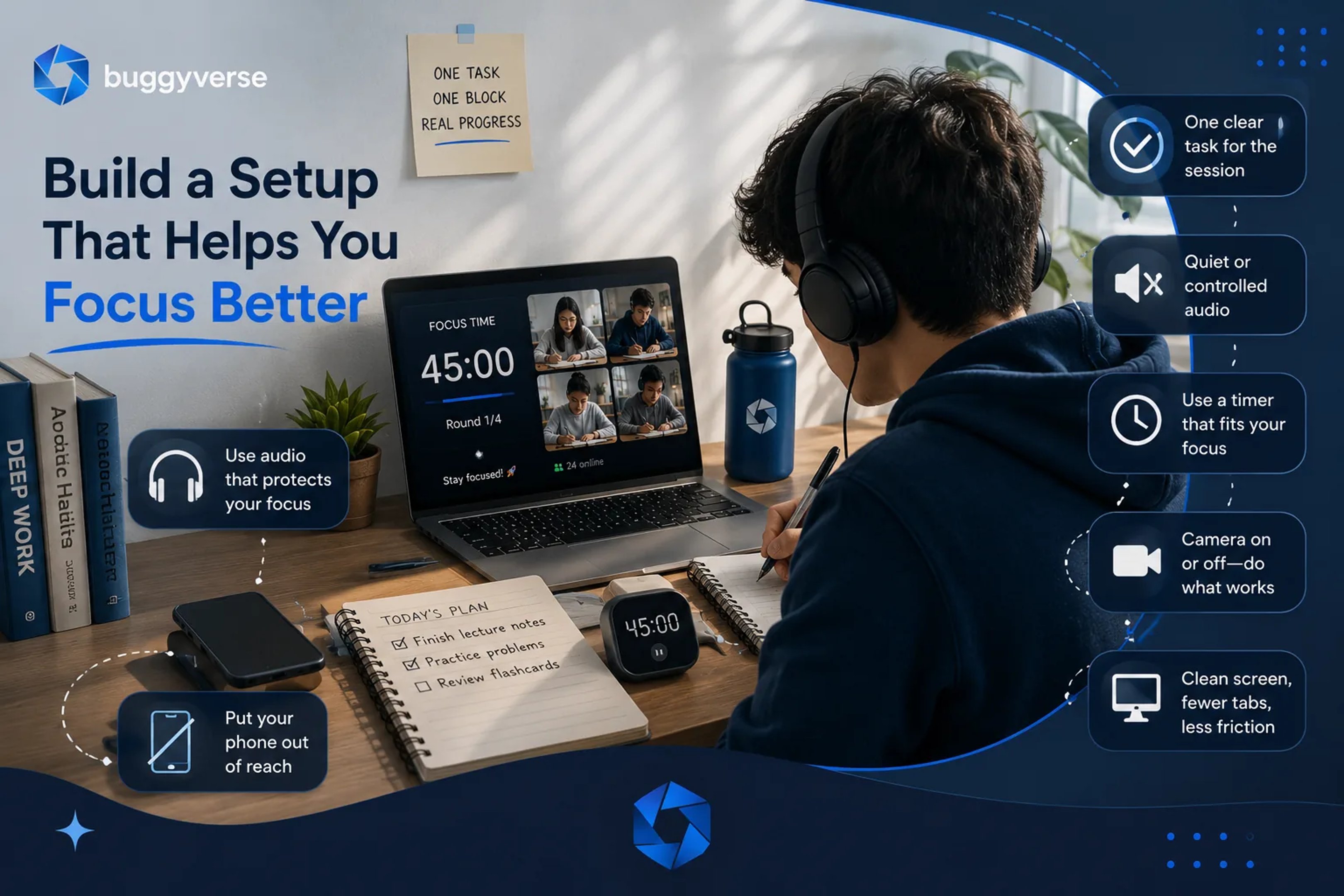
Best Virtual Coworking Setup for Students

How to Stay Accountable Without Burning Out While Studying