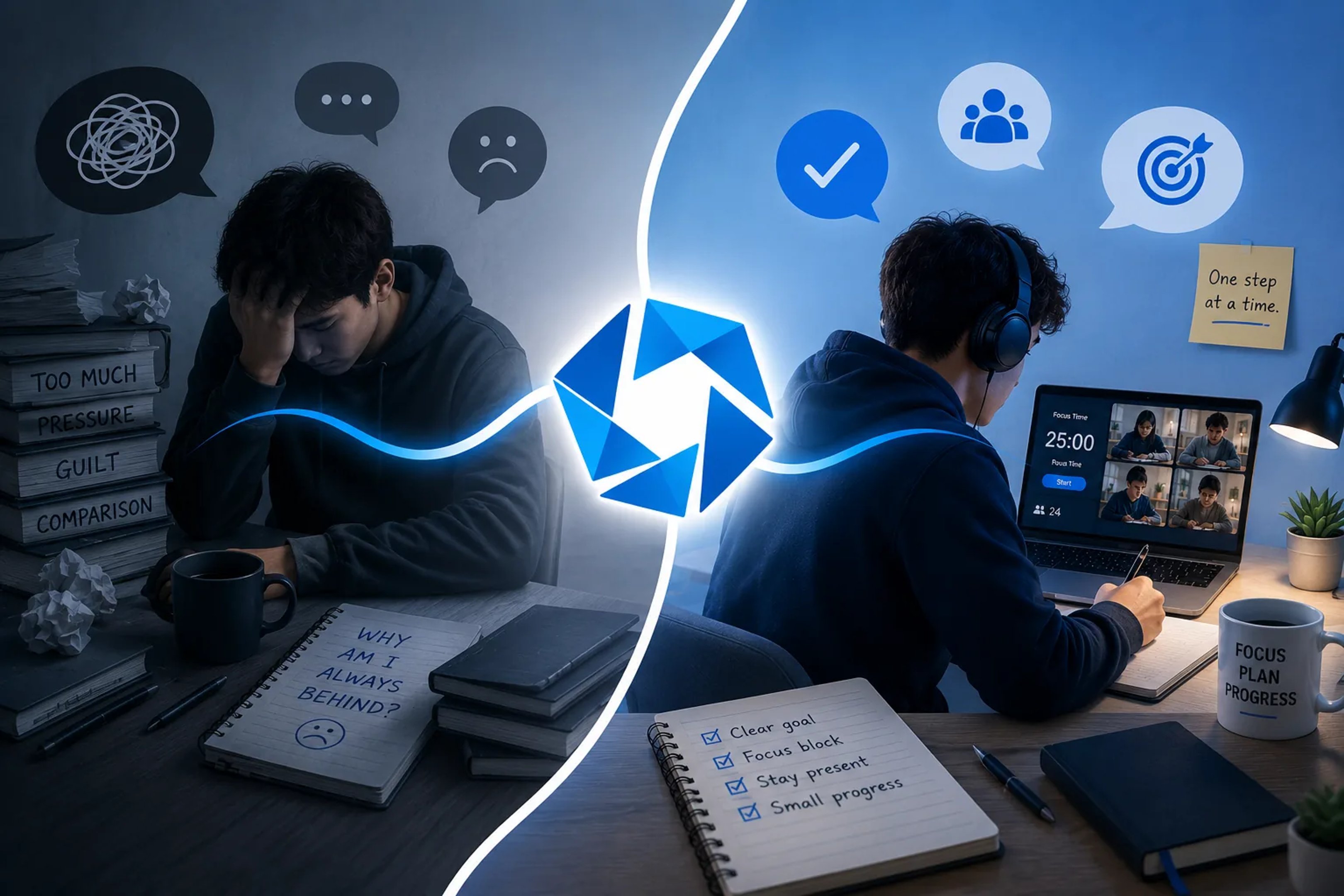
Plenty of students know that accountability helps. It is easier to show up for a study block when someone else is expecting you, when a timer is running, or when a group is already working.
The problem is that accountability can turn sour fast. A system that starts as motivating can become another source of guilt, anxiety, and pressure. Instead of helping you study, it can make you feel like you are constantly behind.
If that sounds familiar, the answer is not to give up on accountability completely. The answer is to use social accountability without burnout. That means building support around your study life in a way that helps you start, stay focused, and recover when you need to.
This guide explains what healthy social accountability looks like for students, why some accountability systems become exhausting, and how to use study partners or online focus rooms in a way that actually helps.
What social accountability means in student life
Social accountability means using other people to make your study plan more real. That can look different depending on your style:
- A friend who checks in before and after a homework block
- A weekly study group that meets at the same time
- A shared calendar session where everyone works quietly
- An online study room where you join other students for a timed focus block
- A simple message like, "I am finishing my biology notes by 7:30"
At its best, social accountability adds structure and momentum. It makes your plan harder to ignore. It also reduces the lonely feeling that can make studying drag.
At its worst, it becomes performative. You start studying to avoid disappointing people instead of studying to make real progress. That is where burnout starts to creep in.
Why accountability sometimes leads to burnout
Students usually do not burn out because accountability exists. They burn out because the accountability system asks for too much, too often, or in the wrong way.
Here are a few common reasons it backfires:
- The pressure is constant. If every study block feels public, you never get to reset.
- The goals are unrealistic. Oversized plans create repeated failure, even when you worked hard.
- The system depends on guilt. Feeling ashamed may push you for a day or two, but it is not sustainable.
- There is no room for bad days. Students get tired, sick, overwhelmed, and distracted. A rigid system treats normal fluctuation like failure.
- You compare your pace to everyone else. Shared study spaces can help, but comparison can drain motivation if you are not careful.
Burnout often looks less dramatic than people expect. Sometimes it is not total collapse. Sometimes it is quietly dreading your study group, avoiding check-ins, or feeling tense every time someone asks how your work is going.
Signs your accountability system is too intense
If you want a healthier setup, it helps to notice the warning signs early.
- You feel anxious before study check-ins instead of supported by them.
- You lie about progress because being honest feels embarrassing.
- You keep joining sessions even when you clearly need a real break.
- You measure success only by perfect follow-through.
- You feel like you are always being watched, judged, or compared.
- You stop using the system entirely because it feels heavy.
A good accountability system should create a little friction against procrastination, not constant emotional strain.
What healthy accountability feels like
Healthy accountability is lighter than many students expect. It does not require intense supervision. It does not require turning every study session into a performance. Usually, it works best when it gives you three things:
- A clear start point. You know when the session begins and what you are doing first.
- A calm sense of presence. Someone else is there, but they are not hovering over you.
- A reasonable end point. You can finish the block, report back honestly, and move on.
That is why quiet study sessions often work better than intense accountability speeches. Most students do not need more pressure. They need better structure.
How to stay accountable without burning out
1. Make the unit of accountability small
Do not build accountability around giant promises like "I will fix my entire semester this week." Build it around one block, one assignment, or one chapter.
Smaller commitments are easier to start and easier to complete honestly. They also help your brain trust the system instead of fearing it.
Better examples:
- "I am doing 30 minutes of calculus practice from 4:00 to 4:30."
- "I am outlining my history essay before dinner."
- "I am reviewing flashcards for one Pomodoro block."
2. Use check-ins, not surveillance
A quick start message and a quick finish message are usually enough. You do not need constant updates every ten minutes. You do not need someone monitoring whether your eyes stay on the screen.
Simple is better:
- Start: "My goal is two pages of chemistry notes in the next 45 minutes."
- End: "Done. I finished one and a half pages, so I will continue tomorrow."
Notice that the second update is still useful even if the goal was only partly finished. Honest reporting matters more than perfect reporting.
3. Choose low-pressure people
The best study partner is not always your smartest friend or most disciplined classmate. It is often the person who helps you feel steady, honest, and able to restart.
A good accountability partner usually:
- respects realistic goals
- does not mock missed targets
- understands that consistency matters more than intensity
- can be direct without making you feel small
If someone makes every check-in feel like a judgment, they may be a poor accountability fit for you, even if they mean well.
4. Put time limits on the social part
Many students accidentally turn accountability into another task. They spend too much time arranging sessions, explaining their plans, apologizing for delays, or talking about productivity instead of actually working.
Keep the setup short. A few minutes is enough. The point is to study, not to manage a complicated accountability ritual.
5. Build in recovery on purpose
One reason burnout grows is that students only "earn" rest after ideal performance. That mindset is brutal during exam season or stressful weeks.
Instead, decide ahead of time what recovery looks like. That might mean:
- taking one session off after a long school day
- using a shorter focus block when energy is low
- switching from a high-effort task to a lighter review task
- joining a room just to restart gently, not to push for maximum output
Recovery is not cheating. It is part of staying consistent long enough to actually learn.
6. Track effort and follow-through, not just outcomes
If your only definition of success is finishing everything exactly as planned, accountability will feel punishing. Student life is too unpredictable for that.
A better question is: Did I show up and move the work forward?
Sometimes a good session means finishing the full task. Sometimes it means staying with a difficult subject for 25 focused minutes when you would otherwise have avoided it completely. That still counts.
7. Use group rooms for momentum, not comparison
Online study rooms can be great for accountability because they create a shared work atmosphere without forcing constant interaction. You show up, join a timer, and let the room help you settle in.
But the room works best when you treat it as a source of rhythm, not as a scoreboard. If you spend the whole session wondering whether other people are doing more than you, the benefit disappears.
Try this mindset instead: other students are there to make the block feel real, not to rank your worth.
Simple accountability setups that do not feel exhausting
If you want practical options, start here.
The two-message method
- Send one message before you start with your exact task and time block.
- Send one message after you finish with an honest update.
This works well for friends, classmates, or a small group chat.
The quiet co-study block
- Pick a 25, 45, or 60 minute session.
- Say your goal at the start.
- Work quietly.
- Share one sentence at the end about what happened.
This is often enough structure for students who want support without a lot of talking.
The online focus room reset
- Join a focus room when you feel resistance building.
- Choose one realistic task.
- Work through one timed block.
- Leave after the block if you need to, or continue if your momentum is back.
This setup is useful when you do not want to coordinate with a friend every time you need accountability.
What to do if accountability makes you anxious
If accountability has started to feel stressful, scale it down before you abandon it completely.
You can try:
- shorter study blocks
- less frequent check-ins
- camera-off sessions
- private progress logs instead of live reporting for a few days
- a different accountability partner
The goal is not to prove that you can handle maximum pressure. The goal is to find the lightest structure that still helps you begin.
Final takeaway
Social accountability works best when it helps you feel supported, not cornered. A good system nudges you into action, gives your study block a real shape, and lets you be honest about what happened. It should reduce friction, not increase fear.
If you want to study more consistently, aim for accountability that is clear, gentle, and repeatable. Small promises kept honestly will help you more than dramatic plans you cannot sustain.
If solo studying keeps stalling out, a quiet online focus room can be a simple way to add that extra bit of structure without turning your study life into a performance. Join for one block, keep your task small, and let the session do its job.