
Why Studying Alone Feels So Hard — and How Online Study Rooms Can Help
You can like your classes and still hate studying alone.
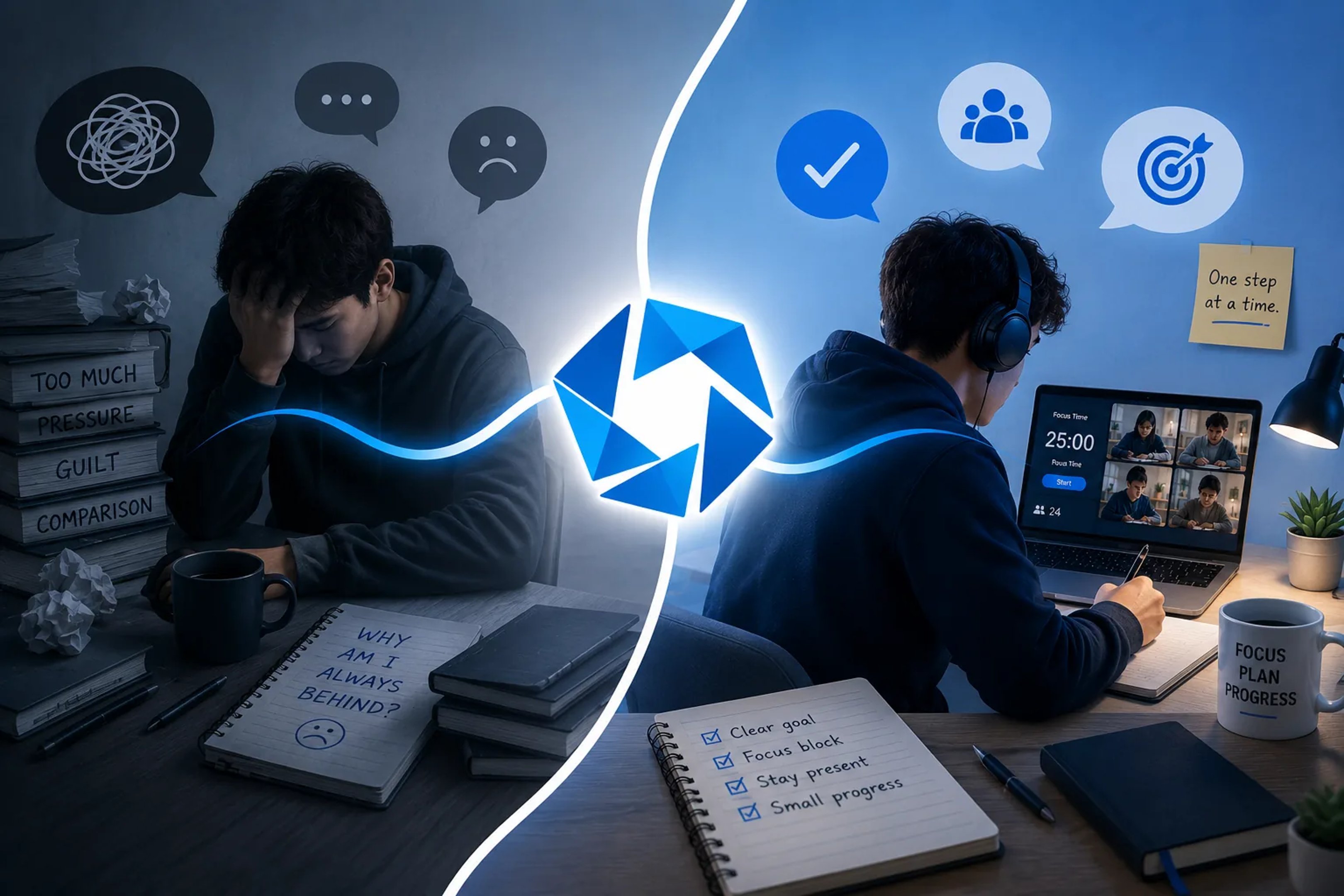
After a few hours in the same bedroom, dorm, apartment, or quiet corner of the library, the problem may stop being the assignment. You just miss having other people around.
Nobody is working beside you. Nobody notices whether you finish the chapter or disappear into your phone for forty minutes. You take a break, come back, and somehow the room feels even quieter than before.
That kind of isolation is easy to dismiss as a productivity problem. Sometimes it is not. Humans are social, and studying is one of the few parts of student life that can require spending hours alone while still demanding concentration, motivation, and emotional energy.
Online study rooms cannot cure loneliness, and they are not a substitute for friends, community, counseling, or mental-health care. But they can add something that solo timers and productivity apps cannot: the presence of other people going through the same ordinary struggle of trying to get their work done.
Last updated: August 2026
Feeling Lonely While Studying Is More Common Than It Looks
Feeling lonely while studying does not necessarily mean you have no friends.
You might have friends you text every day and still spend most of your actual study time alone. You might attend classes on campus and then go home to complete everything by yourself. You might be an online student whose classmates exist mostly as names inside a learning management system.
Commuter students, international students, transfer students, remote learners, and people taking asynchronous courses can all experience the same strange situation: you are surrounded by an educational institution, but the work itself happens in isolation.
Recent U.S. data suggests the broader problem of disconnection is substantial. In the American Psychological Association's 2025 Stress in America survey, 54% of adults said they felt isolated from others at least some of the time, while half reported feeling left out or lacking companionship.
College-specific research paints a similarly serious picture. The 2025 Lumina Foundation-Gallup State of Higher Education report found that emotional stress remained one of the main reasons students considered stopping their education. Among people who had stopped out and identified emotional stress as a reason, 60% identified loneliness or isolation as one source of that stress.
None of that means an online study room is a treatment for loneliness. It does show why student success cannot always be reduced to better calendars, stricter discipline, or another productivity technique.
Sometimes the environment itself feels lonely.
Why Studying Alone Can Feel Harder Than Studying Around Other People
Think about the difference between trying to study alone at home and walking into a library where twenty other people already have their laptops open.
Nobody in the library needs to talk to you. They do not need to know your name. They may be studying completely different subjects.
Their presence still changes the room.
Opening your notes feels normal because everybody else is working. Staying seated feels easier because the environment is already built around concentration. Even taking a short break feels different when the people around you are eventually returning to their work too.
Online education removes much of that passive social structure.
Your professor can upload excellent lectures. Your course can have perfect assignments. Your calendar can tell you exactly what to do. None of those things create the feeling of another person quietly working beside you at 11:30 at night.
Research on online learning often describes this missing element as social presence: the degree to which people in a digital environment feel that other participants are genuinely there rather than simply usernames on a screen. Research comparing online and face-to-face learning has found social presence to be particularly important to satisfaction and learning experiences in online settings.
The Problem Is Not Always Motivation
Productivity advice often assumes that if you are not studying, you need more discipline.
Sometimes you do.
But imagine you have already spent three semesters studying mostly from the same desk. You wake up, attend an online lecture, eat something, reopen the laptop, complete an assignment, watch another lecture, and study for tomorrow's exam.
The problem might not be that you suddenly stopped caring about school.
The environment has become emotionally flat.
There is no transition between “I am hanging out” and “I am studying.” There is no walk to the library. No friend dropping their backpack beside you. No person across the table silently reminding you that everyone has work to finish.
When that happens, adding another timer may help a little. Adding another to-do list may help a little.
But neither one changes the fact that you are still alone.
What an Online Study Room Actually Changes
An online study room is a virtual space where people study at the same time from different places.
Depending on the platform, people might use cameras, timers, goals, chat, screen sharing, Pomodoro sessions, or simply remain quietly present while everyone works.
The useful part is not necessarily the technology.
It is the fact that when you open your laptop, somebody else is already there.
That can change a solo study session in several practical ways.
1. Starting feels less lonely
There is a difference between opening an empty productivity dashboard and entering a room where several people are already working.
The second environment gives you immediate social context. You are not creating the entire study session from zero. You are joining one that already exists.
2. Other people create gentle accountability
You do not always need someone checking whether you completed question 14.
Sometimes seeing other people remain focused is enough to make closing the textbook after eight minutes feel slightly less appealing.
This is softer than one-to-one body doubling on a service such as Focusmate. Nobody has to be personally assigned to you. For students who find direct accountability stressful, group presence can feel more natural.
3. Breaks stop feeling like the end of the session
One of the easiest ways to lose a study session is to take a five-minute break that quietly becomes an hour.
In a shared room, there is still somewhere to return to.
Other members may still be working. A timer may be running. The room did not disappear just because you stood up to make coffee.
4. Familiar people can turn studying into a routine
A study room becomes more useful when you begin recognizing people.
Maybe you never become close friends. Maybe you do.
Either way, seeing the same username during your evening study session can make the space feel less anonymous. Eventually, “I should study” can become “I am going to the room.”
That difference sounds small, but routines are often built around places and people, not abstract intentions.
You Do Not Have to Talk to Benefit From Other People Being There
One reason some students avoid social study tools is that they assume joining means they have to make conversation.
It does not.
There is a useful middle ground between studying completely alone and joining a group call where everyone talks for half the night.
You can enter a room, say hello if you want, set a goal, start a timer, and work.
That is enough.
For some students, the best online study community is one where conversation exists but is not compulsory. You can interact during a break and then return to silence when the focus block starts.
The goal is not to turn studying into social media.
The goal is to make solitude optional.
Camera On or Camera Off?
Cameras can make virtual body doubling more powerful because other people can see that you are physically present.
They can also make people uncomfortable.
Maybe your room is messy. Maybe you are eating. Maybe you study at midnight in pajamas. Maybe being watched makes you more anxious instead of more focused.
There is no reason every student should need the same level of visibility.
Some platforms, particularly one-to-one accountability services, rely heavily on cameras. Other online study rooms let you decide.
On Buggyverse, camera use is optional. You can turn it on when seeing and being seen helps, leave it off when you need privacy, and still remain part of the room.
If you want a deeper comparison, read our guide to camera-on vs. camera-off focus sessions .
Online Study Rooms Are Not a Replacement for Real Relationships
This distinction matters.
Seeing eight people studying online can make an evening feel less isolated. It cannot replace having people you trust, spending time with friends, talking with family, participating in campus life, or getting mental-health support when you need it.
Loneliness is also more complicated than simply being physically alone. You can be in a crowded classroom and feel disconnected. You can spend an evening alone and feel perfectly content.
The American Psychological Association defines loneliness around the distress that comes from perceived social isolation. In other words, the important issue is not just the number of people around you. It is whether you feel meaningfully connected.
An online study room should therefore be understood as one small piece of a healthier study environment, not as therapy.
If loneliness, anxiety, depression, or emotional distress is interfering significantly with your daily life, classes, sleep, or relationships, consider talking with someone you trust or using the counseling and support resources available through your school or community.
Who Can Benefit Most From Studying With Others Online?
Online study rooms can be useful for anyone, but they are especially relevant when traditional study communities are difficult to access.
- Online students who rarely share a physical classroom with classmates.
- Commuter students who leave campus soon after class.
- International students studying far from their usual support network.
- Students studying late at night after libraries or campus spaces close.
- People preparing for major exams who spend long stretches reviewing alone.
- Remote workers and developers who also experience long periods of isolated computer-based work.
- Students who struggle to start tasks when nobody else is working nearby.
You do not need to identify as “lonely” for shared studying to help.
Sometimes you simply focus better when the room does not feel empty.
How to Use an Online Study Room Without Turning It Into Another Distraction
Social studying only works if the social part does not replace the studying.
A few habits make a big difference.
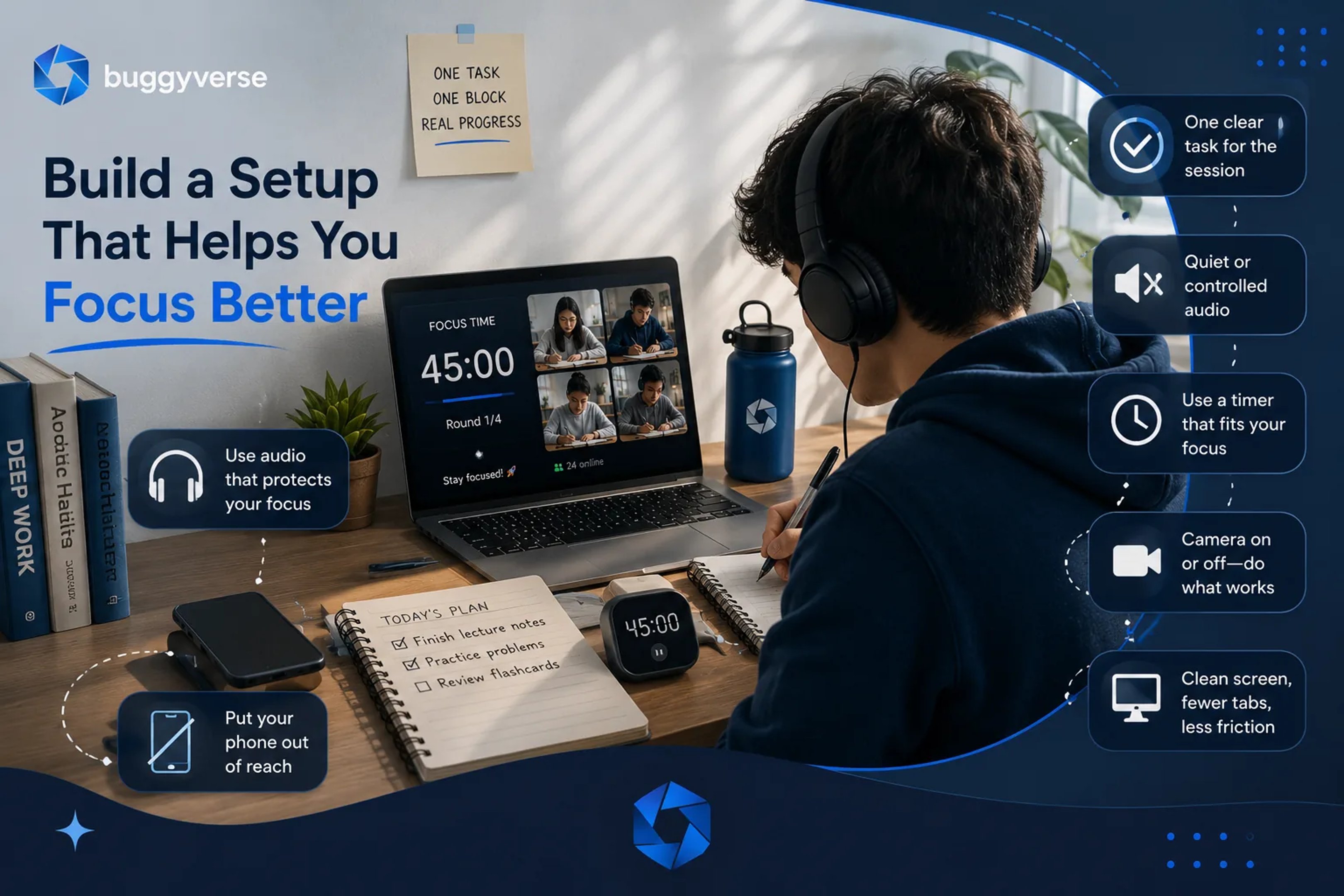
Enter with one clear goal
Do not start with “study chemistry.”
Try something you can actually finish: complete questions 1–15, review chapter 6, or write the first 500 words.
Use chat during breaks, not continuously
A room full of friendly people can become just as distracting as a group chat.
Conversation is useful when it creates community. It stops being useful when you spend the entire focus block watching messages arrive.
Find a room you actually want to return to
The biggest room is not necessarily the best room.
A smaller space with familiar people may provide more of the connection you are looking for than hundreds of anonymous cameras.
Use the same room at roughly the same time
Repetition increases your chance of encountering the same people.
That is how a virtual room can slowly start feeling like your study place instead of another website you visited once.
How Buggyverse Approaches the Problem
Buggyverse was built around a simple idea: studying online should not have to mean studying alone.
Instead of treating every session as a one-to-one appointment, Buggyverse uses persistent public and private study rooms. You can enter a room, see other people studying, set a focus goal, use timers, chat when appropriate, share your screen, and decide whether you want your camera on.
The community part matters because the people in the room are not only there to supervise you. They are working too.
Somebody might be studying calculus in Georgia while another student is preparing for an exam in Europe and somebody else is finishing an assignment in Asia. They do not need to be working on the same subject for the room to feel shared.
Buggyverse is newer and smaller than platforms such as StudyStream, so room activity can vary by time of day. But smaller recurring rooms can also make it easier to recognize people and build an actual study routine around them.
Core room access is free.
What If You Prefer One Person Instead of a Group?
Group rooms are not the best accountability format for everyone.
If you need one specific person expecting you to arrive at a specific time, a one-to-one body-doubling service such as Focusmate may provide stronger pressure.
Focusmate pairs people for timed video sessions. Buggyverse instead gives you a room you can enter and return to.
Neither model is universally better.
If direct accountability gets you moving, choose the partner model. If you want background presence, camera flexibility, longer sessions, and the possibility of building a community, choose the room model.
We compare both approaches in detail in Buggyverse vs. Focusmate .
Frequently Asked Questions
Why do I feel lonely when I study?
Studying often involves long periods of individual concentration, especially for online students or people studying from home. Feeling lonely does not necessarily mean you dislike studying or lack motivation. You may simply be missing the social presence that naturally exists in classrooms, libraries, and shared study spaces.
Can studying with other people online help with loneliness?
It can make studying feel less isolated by adding shared presence and opportunities for connection. An online study room is not a treatment for loneliness or a replacement for meaningful relationships, but some students find that working around other people makes long solo sessions feel more manageable.
What is an online study room?
An online study room is a digital space where people study at the same time. Depending on the platform, rooms may include cameras, focus timers, goals, chat, screen sharing, ambient sound, or Pomodoro sessions.
If you are new to them, read What Is an Online Study Room?
Do I have to talk to people in an online study room?
Usually not. Many people join simply to work around others. On Buggyverse, you can participate in a room without keeping a conversation going.
Do I need my camera on?
It depends on the platform. Some body-doubling services require video. Buggyverse makes camera use optional.
Are online study rooms only for college students?
No. High school students, university students, people taking online courses, developers, remote workers, exam candidates, and anyone doing long periods of focused work may benefit from shared study environments.
Are online study rooms good for mental health?
It is better not to treat online study rooms as a mental-health intervention. Their practical benefit is that they can add social presence, routine, and interaction to work that would otherwise happen alone. Anyone experiencing significant or persistent emotional distress should seek appropriate support beyond a study platform.
You May Not Need More Motivation. You May Need Other People Around.
There are nights when studying alone is completely fine.
And there are nights when opening another silent tab, starting another timer, and staring at the same desk feels heavier than the assignment itself.
If that happens often, the answer does not have to be another productivity system.
Try changing the environment.
Find a room where other people are working. Set one goal. Study for one block. You do not have to turn your camera on. You do not have to introduce yourself to everyone. You do not have to suddenly become social.
Just stop doing every difficult hour alone.
Sources and Further Reading
- American Psychological Association — Stress in America 2025: A Crisis of Connection
- American Psychological Association — Addressing Loneliness
- Lumina Foundation and Gallup — State of Higher Education 2025
- Computers & Education — Social Presence in Face-to-Face and Online Learning
- Computers & Education — Designing Sociable Online Learning Environments