Most students do not struggle because they are lazy. They struggle because studying often begins with friction. You sit down tired, open your laptop, think about everything you still have to do, and suddenly the work feels heavier than it should. When that happens often enough, consistency breaks.
That is where habit loops help. A good habit loop reduces the effort required to begin. It gives your brain a repeatable pattern: a cue that starts the behavior, a routine that carries it forward, and a reward that makes the behavior worth repeating.
For studying, this matters a lot. Motivation rises and falls. Deadlines create pressure, but pressure alone is not a durable system. If you want reliable focus over weeks and months, you need a structure that works even on average days, not just on desperate ones.
In this guide, we will break down how habit loops work, how they apply to study sessions, and how to build a version that is realistic for student life.
What is a habit loop?
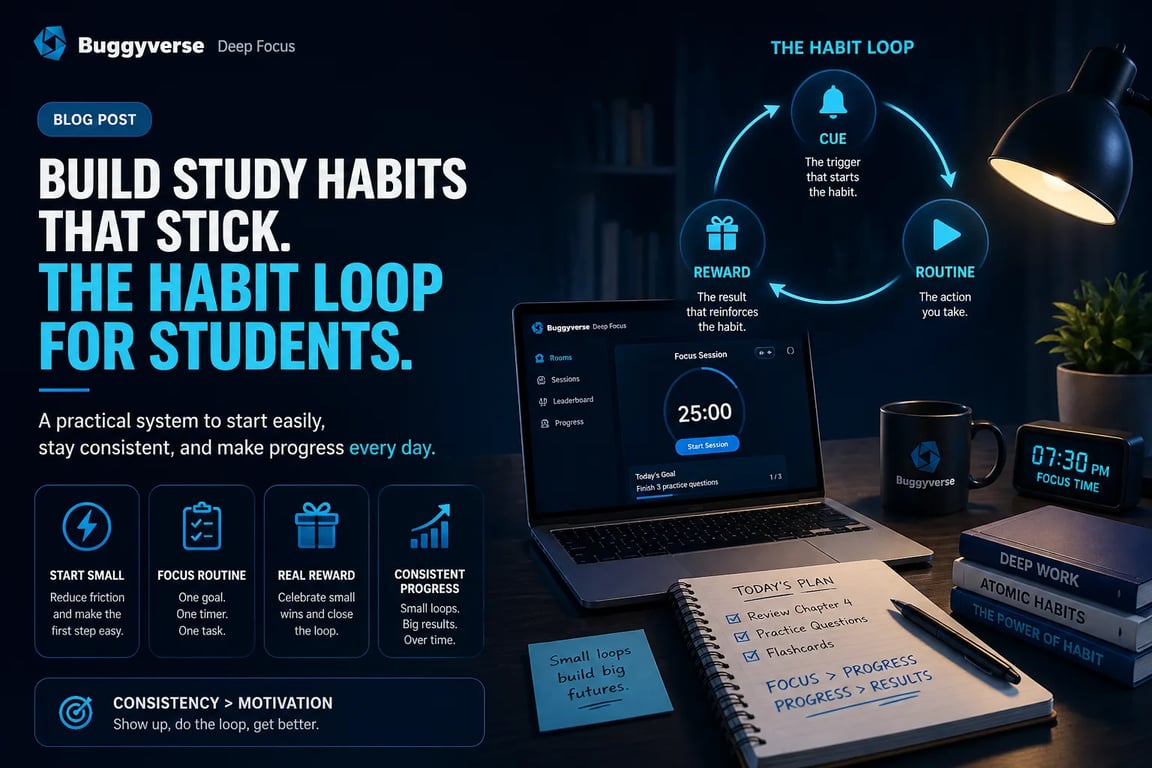
A habit loop is a simple behavior cycle with three parts:
- Cue: the trigger that tells your brain it is time to start.
- Routine: the action you take.
- Reward: the result that reinforces the behavior.
This model is useful because it turns studying from a vague intention into an observable system. Instead of saying “I should study more,” you can ask three better questions:
- What reliably starts my study session?
- What exact behavior counts as beginning?
- What makes me want to do it again tomorrow?
Those questions expose weak points fast. If your cue is inconsistent, you forget to start. If your routine is too big, you delay it. If your reward is nonexistent, the habit feels like pure punishment.
Why students fail to build study habits
Many study systems fail because they are built around ideal days. They assume high energy, perfect timing, and strong willpower. Real student life is messier. Schedules shift. Sleep gets cut short. Stress spikes around exams. A system that only works when you feel great is not a system.
The most common mistakes look like this:
- The cue is vague. “I will study later” is not a trigger.
- The routine is too ambitious. Planning a three-hour deep work block as a starting habit usually collapses.
- The reward is too delayed. Grades and long-term success matter, but they are too far away to reinforce today’s behavior on their own.
- There is too much friction. If you have to decide what to study, gather materials, choose a timer, and fight distractions every time, your brain will look for escape.
A working habit loop makes the start small, clear, and repeatable.
Step 1: Build a cue you can trust
The cue is the front door of the habit. If the cue is unreliable, the habit stays fragile. Good study cues are specific and easy to recognize.
Examples of strong cues include:
- After my 7:00 PM dinner, I start a 25-minute study block.
- When I open my desk lamp, I join my focus room and write today’s task.
- At the end of my last class, I go straight to the library and begin my first review block.
Good cues are anchored to something stable: time, location, or an event that already happens. This is why environment matters so much. If your cue depends on mood, the habit will wobble. If it depends on a repeatable trigger, your start becomes more automatic.
If you use online study rooms, the room itself can become part of the cue. Joining the same room, seeing the same timer rhythm, or posting your session goal can signal to your brain that it is time to work.
Step 2: Make the routine smaller than your ambition
This is the part most people get wrong. They confuse the full version of the behavior with the minimum version that keeps the habit alive.
Your routine should be small enough to start even when your energy is mediocre. That does not mean you stay small forever. It means you make starting easy enough that consistency wins.
A good starter routine might be:
- Open your notes.
- Set one study goal.
- Start a 25-minute timer.
- Stay with one task until the timer ends.
That may sound basic, but basic is powerful when repeated. Once you begin, it is often easier to continue. The first win is not three hours of perfect focus. The first win is getting into motion without drama.
If you want to study for two hours eventually, do not make two hours the habit. Make starting the habit. Then let volume grow after the pattern becomes stable.
Step 3: Add a reward your brain can actually feel
Rewards do not have to be elaborate. They just need to give the brain a reason to associate the routine with something positive or complete.
Useful study rewards include:
- Checking off a session on a tracker.
- Writing a short “done” note after a focus block.
- Taking a real break without guilt.
- Sharing progress in a study room or accountability group.
- Seeing your streak or weekly total grow.
The reward should reinforce completion, not sabotage it. A short walk, a refill, a stretch, or a visible streak works better than disappearing into social media for forty minutes. The point is to close the loop cleanly.
A simple habit loop for studying
If you want a practical example, use this:
- Cue: At 7:30 PM, I sit at my desk and open Buggyverse.
- Routine: I post my goal, start one 25-minute focus session, and work only on that task.
- Reward: I mark the session complete, take a 5-minute break, and log one sentence about what I finished.
This works because it is concrete. It does not ask you to become a different person overnight. It gives you one clean loop you can repeat.
How to reduce friction before the habit starts
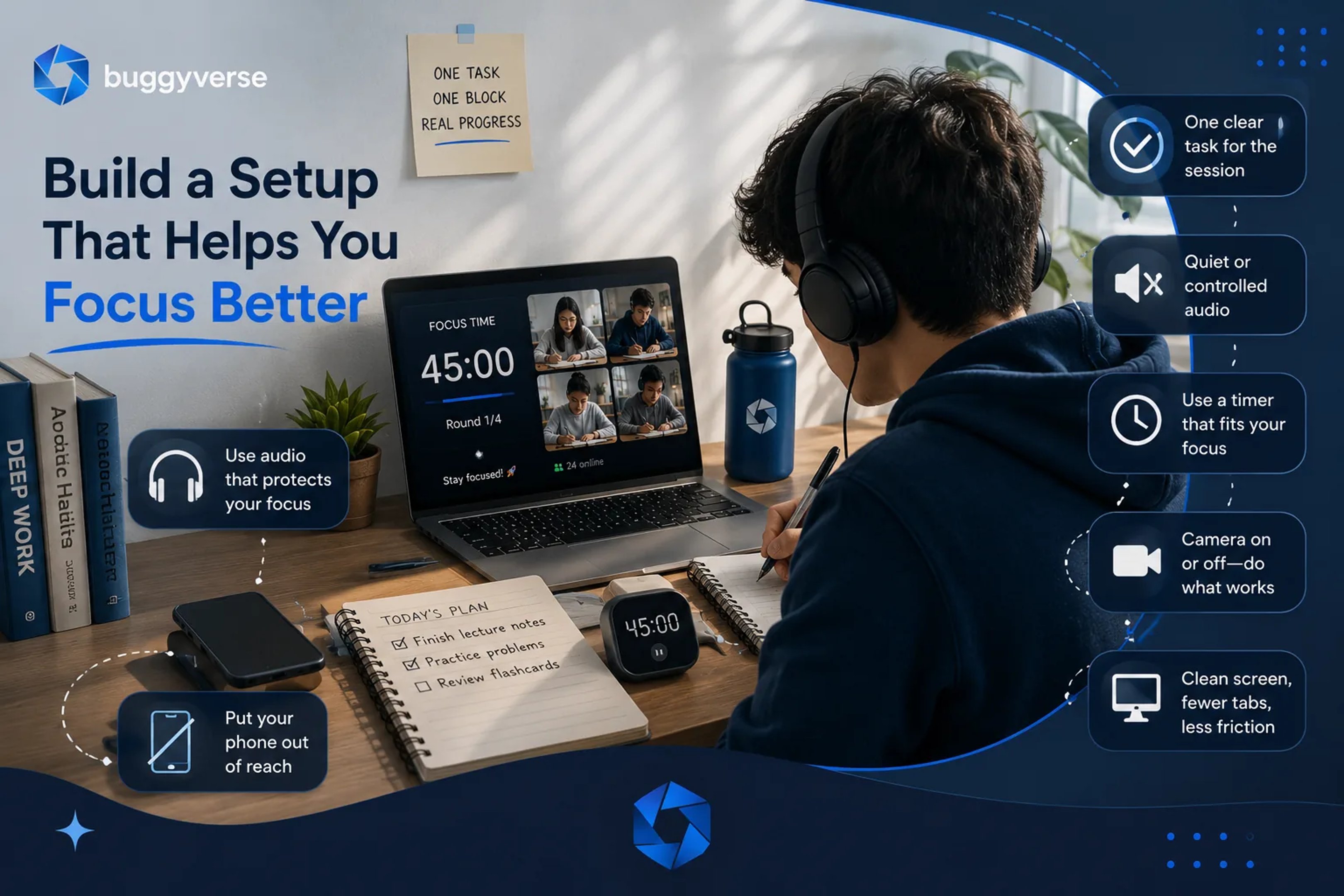
Habit loops work better when setup costs are low. If you have to make too many decisions before the first five minutes of studying, resistance goes up. Friction is not always dramatic. Often it looks like small delays that quietly kill momentum.
Reduce friction by preparing in advance:
- Choose tomorrow’s first task the night before.
- Keep your materials in one obvious place.
- Use a fixed study location when possible.
- Open the tabs or apps you need before your session starts.
- Use the same timer structure each day so you are not re-deciding the format.
One of the hidden benefits of study rooms is that they reduce startup decisions. When the environment already has a timer, a shared focus norm, and visible accountability, you can move into the routine faster.
Use identity carefully: become the kind of student who starts
Identity-based thinking can strengthen a habit loop, but it should stay grounded. Instead of saying, “I am going to become a perfect student,” use a smaller and more believable identity statement: “I am someone who starts my study block when the cue happens.”
This matters because identity becomes fragile when it depends on perfection. Miss one day and the whole story collapses. A better identity is operational. It is based on what you do most of the time, not on heroic streaks.
Reliable students are not necessarily the most intense students. They are often the ones who know how to restart quickly.
What to do when the loop breaks
Every habit loop breaks sometimes. Travel, illness, exam chaos, family demands, and bad weeks are normal. The goal is not to avoid disruption forever. The goal is to recover without turning one miss into a collapse.
When the loop breaks:
- Return to the smallest version of the routine.
- Do not “punish” yourself by doubling the workload the next day.
- Rebuild the cue first.
- Focus on one successful restart, not on your broken streak.
A lot of students get stuck because they think recovery must be dramatic. It does not. Usually the best reset is one ordinary, completed session.
Habit loops for different study needs
Not every student studies the same way. The loop should match the kind of work you actually do.
For reading-heavy courses
- Cue: after class, sit in the same location.
- Routine: read and annotate one section.
- Reward: summarize the section in three bullet points.
For problem-solving courses
- Cue: start after a fixed meal or break.
- Routine: solve three problems or one focused set.
- Reward: mark what you solved without help.
For writing projects
- Cue: open the draft at the same hour each day.
- Routine: write for one timer block without editing everything at once.
- Reward: record word count or section progress.
The point is not to copy someone else’s loop exactly. The point is to use the same structure while adjusting the routine to fit your workload.
How group accountability strengthens the loop
Studying alone can work, but group accountability often makes the cue and reward stronger. When you join a focus room, declare your task, and work alongside others, the loop gains social structure.
That social structure helps in three ways:
- The cue becomes more visible. Joining the room becomes the start signal.
- The routine feels easier to hold. Shared focus reduces drift.
- The reward becomes immediate. You can end the session with a clear check-in or visible progress signal.
This is one reason virtual coworking and online study rooms help students who struggle with consistency. They do not remove the need for discipline, but they lower the activation cost of using it.
Signs your habit loop is working
A good study habit loop usually produces a few clear signs:
- You start with less internal negotiation.
- You know what “beginning” looks like.
- You recover faster after missing a day.
- You need less motivation to get into motion.
- Your study time becomes more predictable week to week.
Notice that none of these signs require perfection. Progress in habit building usually looks boring at first. That is fine. Boring consistency beats dramatic inconsistency.
Final takeaway
Habit loops for studying work because they turn discipline into a repeatable sequence instead of a daily debate. A clear cue starts the session. A realistic routine keeps it manageable. A simple reward closes the loop and makes repetition more likely.
If your current study habit is unstable, do not start by demanding more motivation from yourself. Start by designing a better loop. Make the cue obvious. Make the routine small enough to begin. Make the reward immediate and clean.
Do that consistently, and studying starts to feel less like a fight and more like a system you can trust.