SAT and ACT prep often goes off track for a simple reason: students treat the exam like a giant motivation challenge instead of a repeatable focus problem. They know the test matters. They know the clock is moving. They even know they should be practicing. But the actual work becomes inconsistent because their study sessions are too vague, too reactive, or too exhausting to sustain.
That is where a deep focus framework helps. Instead of asking yourself to feel ready every day, you build a system that tells you what to study, how long to study it, how to review mistakes, and how to keep improving over time.
The point is not to create a perfect prep routine. The point is to create one that survives busy school weeks, low-energy days, and the pressure that builds as test day gets closer.
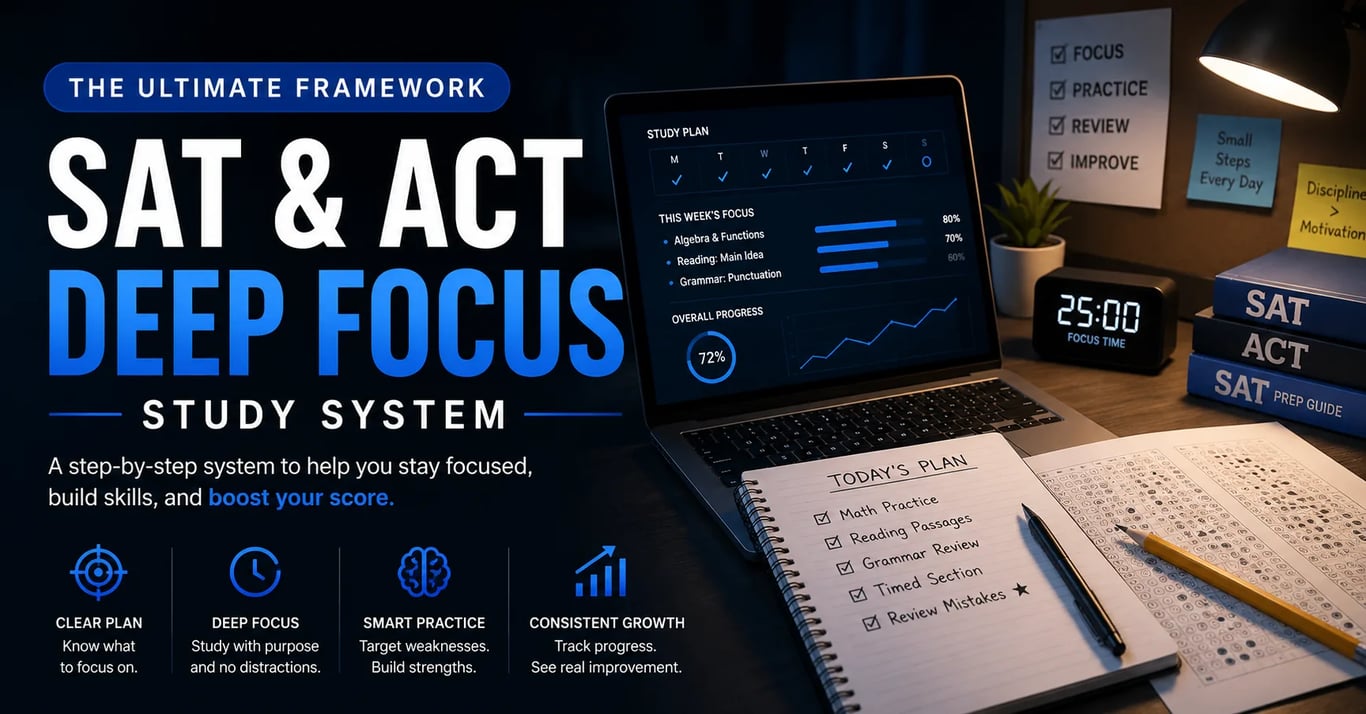
In this guide, we will break down a practical SAT/ACT deep focus framework you can use to study with more clarity, better retention, and less chaos.
Why SAT/ACT prep fails without structure
Many students start with good intentions and a bad system. They bounce between question sets, take random practice sections, watch strategy videos, and review notes whenever they have time. That can feel productive in the moment, but it usually creates uneven progress.
The problem is not effort alone. The problem is fragmented attention. Standardized test prep improves when you can stay with the right task long enough to see patterns, fix mistakes, and build confidence through repetition.
Without structure, sessions turn into shallow contact with the material. With structure, each session has a job and each week has direction.
What “deep focus” means for SAT/ACT prep
Deep focus does not mean studying for six hours straight. It means working in a deliberate way with low distraction and a clear objective. For SAT/ACT prep, deep focus usually includes:
- one subject or skill target per block,
- a defined practice set or review task,
- active error correction,
- enough uninterrupted time to think carefully instead of rushing.
Deep focus matters because the SAT and ACT reward pattern recognition, timing control, and steady reasoning. Those abilities improve faster when your prep blocks are intentional instead of scattered.
Start with a prep map before you build sessions
Before planning your study week, map the prep landscape clearly. You need to know:
- your test date,
- your baseline score or current range,
- your strongest and weakest sections,
- how many hours per week you can realistically sustain,
- what prep materials you will actually use.
This matters because a lot of students create study plans around fantasy availability. A strong framework starts with reality. If school, sports, work, or family commitments limit your week, your plan has to respect that or it will collapse.
Break the exam into skill buckets
SAT/ACT prep becomes easier when you stop treating the exam as one giant challenge and start treating it as a set of trainable skills.
Examples of skill buckets include:
- Math: algebra fluency, word problem translation, timing under pressure, calculator discipline.
- Reading: passage pacing, evidence tracking, inference control, main idea accuracy.
- Grammar/Writing: punctuation rules, sentence structure, concision, rhetorical logic.
- Science or data interpretation: graph reading, experiment logic, quick extraction of relevant detail.
When your prep is divided this way, your study blocks can attack specific weaknesses instead of vaguely “doing test prep.”
Use a three-layer weekly system
A useful deep focus framework has three layers: strategic planning, focused execution, and review.
Layer 1: Strategic planning
At the start of each week, decide what matters most. Pick the one to three skill areas that need the most attention. This keeps your week from getting diluted by too many goals at once.
For example, a weekly focus might be:
- fix careless algebra misses,
- improve reading passage pacing,
- review punctuation and transition questions.
Layer 2: Focused execution
This is the work itself. Use dedicated blocks with one clear objective per session. Do not mix five different tasks into one block unless you are deliberately running a mixed review session.
Layer 3: Review and correction
This is where real score growth often happens. Taking practice questions is necessary, but improvement comes from understanding why you missed what you missed and what pattern caused it.
Students who skip review often repeat the same mistakes for weeks. Students who review carefully turn mistakes into training data.
Build blocks around task type, not just time
A common prep mistake is planning only by duration. Saying “I will study for two hours tonight” is too vague. Better study blocks pair time with a specific task.
Examples:
- 40 minutes of algebra problem sets focused on systems and functions.
- 35 minutes reviewing reading passage errors from the last practice section.
- 30 minutes of grammar drills on punctuation and sentence boundaries.
- 45 minutes of mixed timing work to simulate section pressure.
The time matters, but the task definition matters more. If the task is clear, your attention has somewhere to go.
Separate learning blocks from performance blocks
Not every prep session should feel like a test. Students often make themselves do everything at full speed too early, then get discouraged when accuracy drops. A stronger framework separates learning mode from performance mode.
Learning blocks
These are slower sessions where you are building understanding. You can pause, annotate mistakes, and examine methods carefully. Use these when a skill area is still weak or unfamiliar.
Performance blocks
These are timed sessions where you practice execution under pressure. Use them to build pacing, stamina, and decision-making when the clock matters.
Both matter. Learning blocks build skill. Performance blocks test whether the skill holds up at speed.
Use error logs as the center of your framework
If you want one habit that improves prep quality fast, start keeping a mistake log. Every meaningful miss should answer a few questions:
- What type of question was it?
- Why did I miss it?
- Did I misunderstand the concept, rush, misread, or choose a weak strategy?
- What is the corrective action for next time?
This changes prep from emotional guessing to concrete feedback. Instead of saying “I’m bad at reading” or “math is not clicking,” you start seeing patterns like:
- I lose points on multi-step algebra when I rush setup.
- I miss reading questions when I do not track the author’s claim precisely.
- I get grammar questions wrong when I rely on what sounds right instead of the rule.
That level of detail makes your next study block much more effective.
Match your session length to your real attention span
Deep focus works better when session length is realistic. For many students, 25 to 50 minutes is the right range for a strong prep block. Harder tasks may benefit from slightly longer blocks. Lower-energy days may need shorter ones.
A practical rhythm could look like this:
- one 40-minute block for a skill lesson or drill set,
- a short break,
- one 40-minute block for review or correction,
- a longer reset before starting another subject.
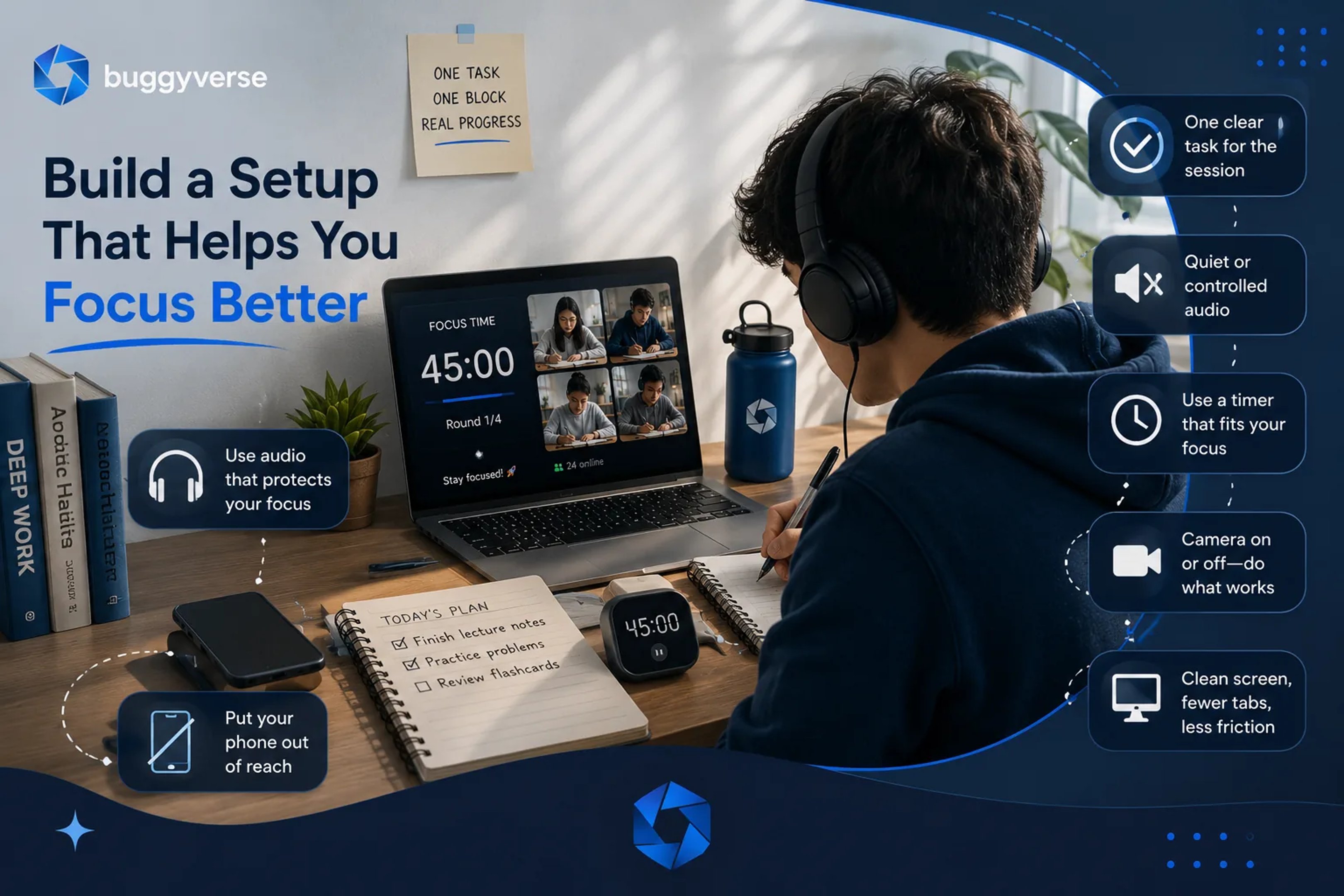
If you use online study rooms or shared timers, they can help protect the block from drift. The key is not intensity theater. The key is repeatable concentration.
Rotate subjects with intent
Most students should not grind the same section in the same way every day. Rotation helps, but random rotation does not. Rotate based on need.
A useful weekly pattern might be:
- High-priority weakness: two to three focused blocks this week.
- Secondary weakness: one to two focused blocks this week.
- Maintenance strength: one lighter block to keep it sharp.
- Full-length or timed work: one larger session on the weekend or another low-friction day.
This prevents both neglect and overreaction. You are not ignoring your strong sections, but you are also not wasting prime energy where it is least needed.
Protect review days after full-length practice tests
Taking a full-length SAT or ACT practice test can feel productive, but the test itself is only half the value. The next review session is often more important than the test day.
After a full-length exam, schedule a dedicated correction block to:
- sort misses by question type,
- identify timing breakdowns,
- mark careless versus conceptual errors,
- choose the next week’s improvement targets.
Without this step, practice tests become score snapshots instead of score-building tools.
Keep one command list for each study day
Prep gets messy when you carry too many competing lists. Use one daily command list with:
- your primary study block,
- one secondary block if time allows,
- one fallback task for low-energy days.
That fallback matters. Some days you will not have the energy for a hard timed section, but you may still be able to review an error log, fix ten grammar questions, or revisit formulas. A weaker session is still better than a skipped day if it keeps the system alive.
A sample SAT/ACT focus week
Here is one example for a student balancing school with test prep:
- Monday: 40-minute math weakness drill, 30-minute correction review.
- Tuesday: 35-minute reading pacing block, 20-minute error log update.
- Wednesday: lighter maintenance block for grammar and rules review.
- Thursday: 45-minute math timing set, then targeted mistake correction.
- Friday: short review block only, protect energy.
- Saturday: timed section or full-length test depending on schedule.
- Sunday: review mistakes, set next week’s skill priorities.
The exact schedule can change, but the framework stays steady: plan, execute, review, adjust.
How focus rooms can support test prep
Standardized test prep can feel isolated, especially when motivation is low. Shared focus environments help by reducing the friction of starting. If you join a room, set one concrete objective, and work through a protected block, the session becomes easier to enter and easier to finish.
This is especially useful for students who know what to do but struggle to begin. A room does not replace the study plan. It supports the execution layer of the framework.
Final takeaway
A strong SAT/ACT deep focus framework does not depend on hype or last-minute panic. It depends on repeatable blocks, clear weekly priorities, honest error review, and a prep rhythm you can sustain under real life conditions.
Map your exam timeline, break the test into skill buckets, separate learning from performance, use error logs aggressively, and give each session a specific job. If you do that consistently, your prep becomes calmer, sharper, and more effective.
Score improvement usually does not come from one heroic weekend. It comes from a system that helps you show up, focus deeply, and learn from each round of practice.