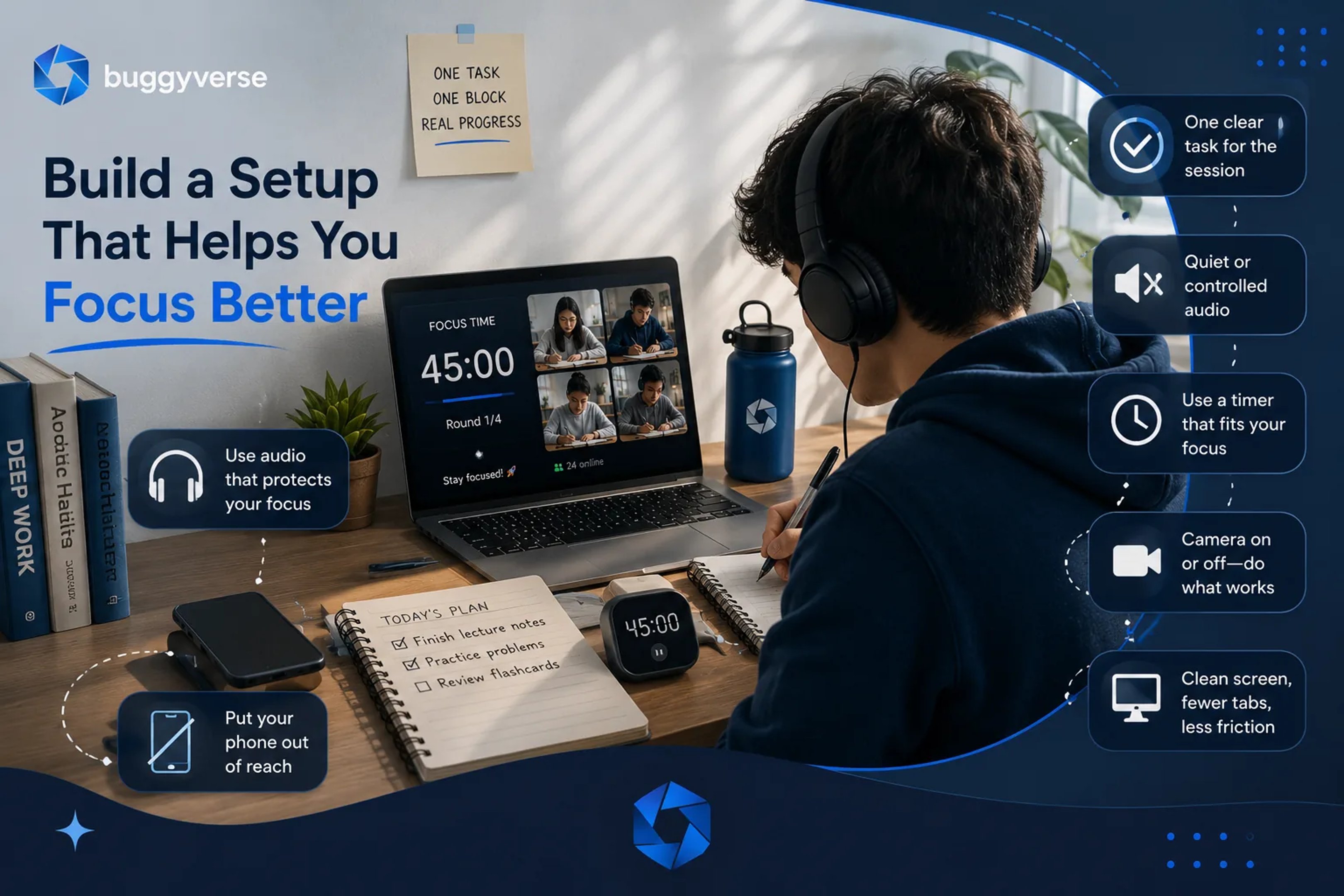

Online study rooms have become one of the most practical ways for students to focus in a world full of distractions. They combine structure, accountability, and social presence without requiring everyone to be in the same physical library or classroom.
For some students, an online study room is simply a quiet place to work with other people on camera. For others, it is a full system for staying consistent through finals, midterms, homework cycles, thesis work, or daily habit-building. The format can look simple from the outside, but the best rooms do several jobs at once: they reduce isolation, create momentum, and make it easier to start when motivation is low.
This guide breaks down what online study rooms are, why they work, how different room styles compare, what features matter most, and how to get real value from them instead of treating them like another tab you leave open in the background.
What is an online study room?
An online study room is a shared digital space where people study at the same time. Depending on the platform, members may use video, audio, timers, text chat, check-ins, or simple presence indicators to work together in a structured way.
The core idea is straightforward: it is easier to start and continue focused work when you are not doing it alone. Even when no one is actively talking, the presence of other people can make a session feel more real. That small shift is often enough to reduce procrastination.
Some rooms are open and casual. Others run with clear focus blocks, break periods, and community rules. Some are designed for deep work, some for body doubling, and some for students who just need a calm place to sit down and finally begin.
Why online study rooms work
Online study rooms work because they solve several common study problems at once.
- They create a start signal. Joining a room makes the session feel official.
- They reduce isolation. Studying near others can make hard work feel lighter.
- They add accountability. People are more likely to follow through when they have declared a goal or joined a shared session.
- They provide rhythm. Timers and visible work blocks reduce decision fatigue.
- They normalize consistency. A room full of people focusing makes focused behavior feel standard rather than exceptional.
The benefit is not magic. The room does not do the work for you. But it changes the environment around the work, and that matters. Most students do not fail because they are incapable. They fail because distraction, friction, and inconsistency keep interrupting good intentions.
Who benefits most from online study rooms?
Online study rooms are useful for a wide range of students, but they tend to be especially effective for people who struggle with one of these patterns:
- Starting late even when they know exactly what they need to do.
- Working well around other people but poorly alone.
- Losing momentum during long exam seasons.
- Feeling overwhelmed by unstructured study time.
- Doing better with body doubling or visible accountability.
- Wanting a calmer alternative to noisy public social platforms.
They are also valuable for remote students, commuters, adult learners, and anyone whose schedule makes in-person study groups hard to maintain.
The main types of online study rooms
Not every study room feels the same. Picking the wrong type can make a good concept feel ineffective, so it helps to understand the main formats.
1. Silent focus rooms
These rooms are built around quiet work. Cameras may be on or optional, microphones are usually muted, and chat is limited. They work well for reading, writing, problem sets, and long concentration blocks.
2. Pomodoro rooms
Pomodoro-style rooms use repeated focus and break cycles such as 25/5 or 50/10. These are useful for students who need frequent resets or who find it easier to commit to one short block at a time.
3. Body doubling rooms
These rooms are especially helpful for students with ADHD or chronic task initiation issues. The value comes less from conversation and more from the simple fact of being visibly present with someone else who is also working.
4. Goal-check-in rooms
In this format, participants share a goal at the beginning and report back later. That simple structure can dramatically improve follow-through because the session has a visible before-and-after.
5. Community-based study rooms
Some platforms build a stronger community around the sessions, with recurring members, room culture, public posts, streaks, or themed events. This can increase retention and make consistency easier over time.
What features matter most in a good online study room?
The best online study rooms are not the ones with the most features. They are the ones with the right features for focus.
Here are the most valuable elements to look for:
- Reliable timers. Shared rhythm helps people settle in and stay on track.
- Clear room expectations. Simple rules reduce friction and awkwardness.
- Flexible camera policy. Some students want body doubling; others need privacy. Good platforms make the room purpose clear.
- Low-friction entry. If joining a session is complicated, people delay starting.
- Light accountability tools. Goal setting, streaks, or check-ins help more than heavy-handed monitoring.
- Calm interface design. A room built for focus should not feel like a noisy content feed.
- Stable moderation and safety. Students focus better when the environment feels respectful and predictable.
Everything else is secondary. Fancy extras only matter if the basic session experience is smooth and dependable.
Camera on or camera off?
One of the biggest questions in online study rooms is whether cameras should be on. There is no universal answer. It depends on the purpose of the room.
Camera-on rooms can be powerful for accountability and body doubling. Seeing other people working creates social pressure in a useful direction. These rooms often feel more active and binding.
Camera-off rooms can be better for privacy, bandwidth, accessibility, and lower-pressure participation. Many students focus better when they are not worrying about being watched.
The key is clarity. The problem is usually not camera-on or camera-off by itself. The problem is ambiguity. When a room labels its expectation clearly, people can choose the format that fits them best.
How timers improve focus in shared rooms
Timers do more than count minutes. They create a visible contract with the session. Once a focus block starts, everyone knows what kind of behavior the room is asking for.
This reduces negotiation with yourself. Instead of asking, “Should I work now, scroll for five minutes, or answer one more message?” the timer answers the question for you. For many students, that reduction in mental chatter is one of the biggest benefits of structured rooms.
Common timer patterns include:
- 25/5: Good for lower energy days, task initiation, and lighter workloads.
- 50/10: Better for essays, reading, and sustained problem-solving.
- 90/15: Strong option for advanced deep work when stamina is high.
The right pattern depends on the task and the student. What matters most is consistency. A shared rhythm helps a group settle into focus faster than an unstructured room does.
How to use an online study room effectively
Joining a room is not enough. To get real value from it, use the session intentionally.
- Decide on one concrete goal before you join. Do not enter with a vague plan to “study.”
- Pick the right room format. Silent room, Pomodoro room, or check-in room should match the task.
- Remove side distractions first. Silence your phone, close unrelated tabs, and bring what you need.
- Respect the room rhythm. If the room is using timers, follow them instead of freelancing constantly.
- Use breaks deliberately. Stand up, stretch, drink water, then come back on time.
- Review your outcome at the end. Check whether you completed the goal you set.
The room gives you structure, but your own clarity still matters. Strong sessions usually start with a specific task and end with a visible result.
Common mistakes students make in online study rooms
Some students try study rooms once, get little benefit, and assume the concept does not work for them. Often the real issue is how the room was used.
The most common mistakes are:
- Joining without a defined task.
- Using a room that is too social for the kind of work they need to do.
- Treating the room as background noise instead of a session container.
- Picking timer lengths that do not match their energy or task type.
- Leaving breaks open-ended and losing the next work block.
- Expecting accountability to work without any self-honesty.
The fix is usually not to abandon study rooms. It is to choose a better room format, simplify the goal, and use the structure more deliberately.
Online study rooms vs studying alone
Studying alone is still the right choice for some tasks. If you need complete silence, privacy, or highly specialized materials, solo work may be best.
But many students do not actually have a “knowledge problem.” They have an execution problem. They know what they need to do, but they struggle to begin, to stay in motion, or to return after interruptions. That is where online study rooms can outperform solo study.
The room changes the cost of starting. It also creates a stronger path back after distraction. When you drift alone, it is easy to lose an hour. In a structured room, the next block is always about to begin.
How online study rooms help during exams
Exam periods are where study rooms often become most valuable. During finals or heavy test cycles, students need repeatable structure more than motivational speeches.
Online study rooms help during exams by:
- Breaking long prep periods into manageable blocks.
- Making it easier to return day after day.
- Reducing the loneliness and stress of marathon study sessions.
- Giving students a reliable place to show up when campus schedules get chaotic.
- Supporting spaced repetition and review cycles through repeat sessions.
That consistency matters more than intensity. Students usually do better with many clean sessions than with one desperate cram.
How to choose the right online study platform
If you are comparing platforms, evaluate them on focus quality, not just popularity.
Ask these questions:
- Does the platform make it easy to start quickly?
- Are rooms designed for real focus or for passive hanging out?
- Is there a timer or clear session structure?
- Can I find the kind of room I actually need?
- Does the community feel calm, useful, and safe?
- Can I build consistency on it, or will it just become another distraction?
A good study platform should lower friction, not raise it. It should help you enter work faster and stay there longer.
Building your own study room routine
Even the best room works better when it is tied to a routine. Instead of joining randomly, connect study-room sessions to specific parts of your week.
Examples:
- Every weekday at 7:00 PM for homework review.
- Saturday morning for long-form writing or exam prep.
- A 50-minute room right after class to convert notes into actions.
- A nightly 25-minute session just to keep the habit alive.
The more predictable the entry point, the less energy you spend deciding whether to work.
Why Buggyverse fits this category well
Buggyverse is built around the idea that focus should feel social enough to keep you engaged, but structured enough to protect the work itself. That means online rooms, flexible timer rhythms, simple accountability, and a calmer environment than generic social platforms.
For students who want more than a static timer but less chaos than a broad community app, that balance matters. The best online study rooms are not just places to be present. They are places that help you keep promises to yourself.
Final takeaway
Online study rooms are not a gimmick. They are a practical answer to one of the hardest parts of studying: starting consistently and staying focused long enough to make progress.
When the room format is right, the social environment is calm, and the session structure is clear, students do not have to rely on willpower alone. They get a repeatable container for focus.
If you have been struggling to study consistently by yourself, an online study room may be the missing layer between good intentions and actual follow-through. The best way to evaluate one is simple: join a session with a clear goal, follow the structure, and see whether it helps you finish more than you would have finished alone.