
What Happened to Studyverse? 7 Best Alternatives in 2026
The original Studyverse.live gave students something that ordinary productivity apps did not: customizable virtual rooms where they could focus beside other people, use simple study tools, and make studying from home feel less isolated.
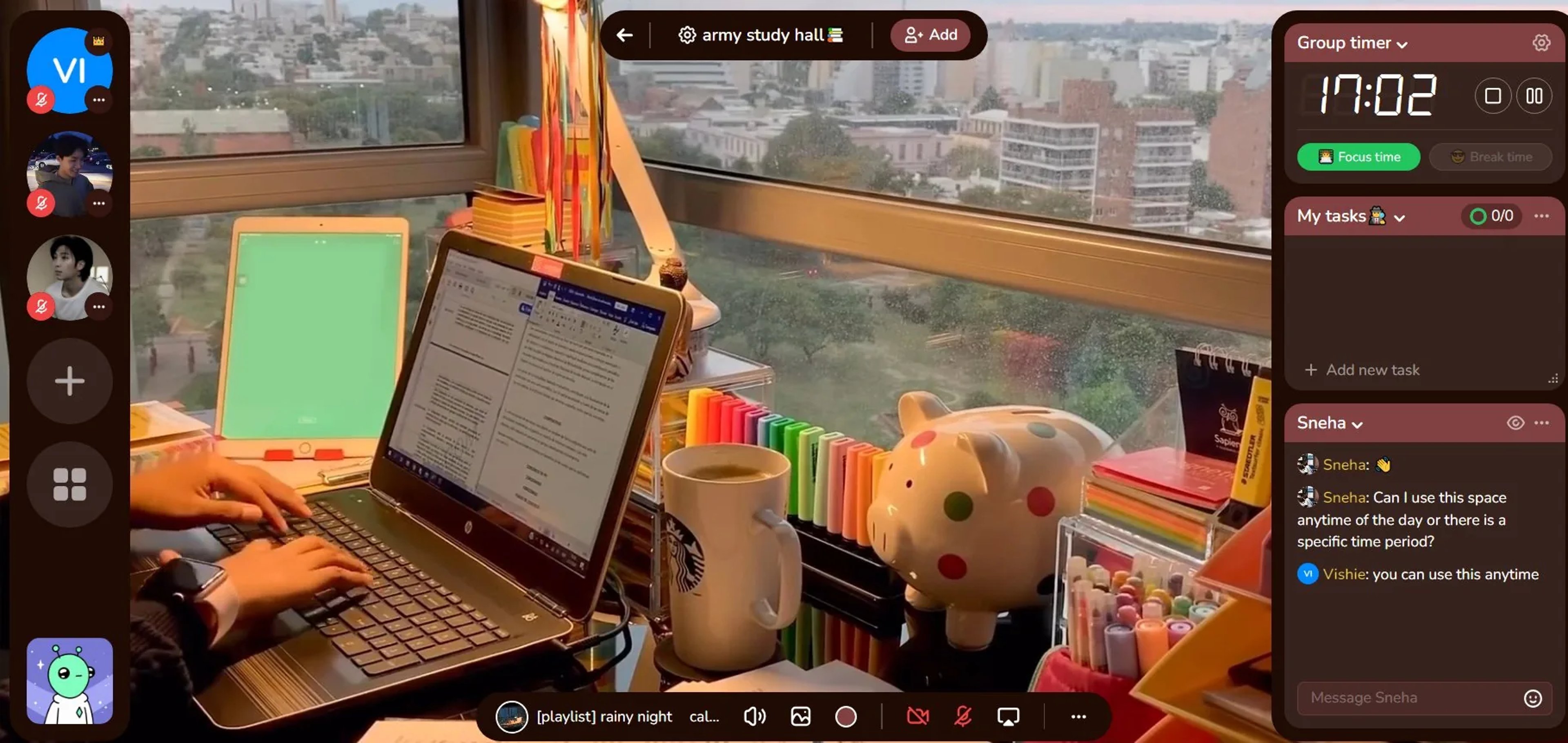
That platform went offline in 2024 and was reported as permanently closed. Since then, several unrelated products have appeared with similar “StudyVerse” names, but they are not the same virtual study-hall platform former users remember.
If you are looking for a Studyverse alternative in 2026, the best replacement depends on what you miss most: live students, aesthetic environments, Pomodoro tools, one-to-one accountability, or a community you can return to.
Last verified: July 2026
Quick Answer: What Are the Best Studyverse Alternatives?
- Buggyverse: best for free community-focused study rooms, optional cameras, chat, timers, and recurring groups.
- StudyStream: best for large, active focus rooms with students online around the clock.
- LifeAt: best for immersive backgrounds, ambient sounds, planning tools, and shared coworking.
- Focusmate: best for scheduled one-to-one body doubling with a real accountability partner.
- Flocus: best for solo Pomodoro sessions, aesthetic dashboards, tasks, sounds, and focus statistics.
- CSW Live: best for students seeking themed browser-based rooms that resemble the old Studyverse format.
- Discord study communities: best for flexible, self-managed study groups with voice, video, text, and screen sharing.
No replacement recreates every part of the original Studyverse exactly. The right choice depends on whether you value live accountability, visual atmosphere, close relationships, or personal productivity tools most.
What Happened to Studyverse?
Studyverse.live was a virtual study-hall platform built around themed rooms, shared presence, timers, task tools, and customizable environments. Students could enter or create a room and work beside other people without needing to organize a formal video call.
The service became unavailable in 2024. Former users reported that its Discord community was informed that the platform had closed permanently, and other productivity companies began publishing guides for displaced Studyverse users. The original service has not returned.
The exact reasons were not clearly communicated to the public. Claims about funding, ownership, or why the platform closed should therefore be treated cautiously unless confirmed by its former operators.
It is also important not to confuse the original Studyverse.live with newer websites and apps that now use similar StudyVerse branding. Some of those products offer study timers, streaks, flashcards, or AI learning tools, but they are separate services rather than a continuation of the original virtual study hall.
What Former Studyverse Users Are Usually Looking For
Studyverse combined several needs that are often separated across different applications. Before choosing a replacement, decide which parts mattered most to you.
- Live presence: seeing other people actively studying so you do not feel completely alone.
- Low friction: opening a room and beginning without scheduling a meeting or configuring several tools.
- Focus structure: using timers, tasks, or visible goals to give the session a clear beginning and end.
- Atmosphere: choosing a room, background, soundscape, or visual style that makes studying more comfortable.
- Community: returning to the same space, recognizing familiar people, and building consistency over time.
Some alternatives are excellent at one of these jobs and weak at the others. A beautiful solo dashboard may recreate the atmosphere but not the social accountability. A massive public room may provide company but not the smaller community feeling.
1. Buggyverse
Best for: free community-focused rooms with optional cameras and recurring members
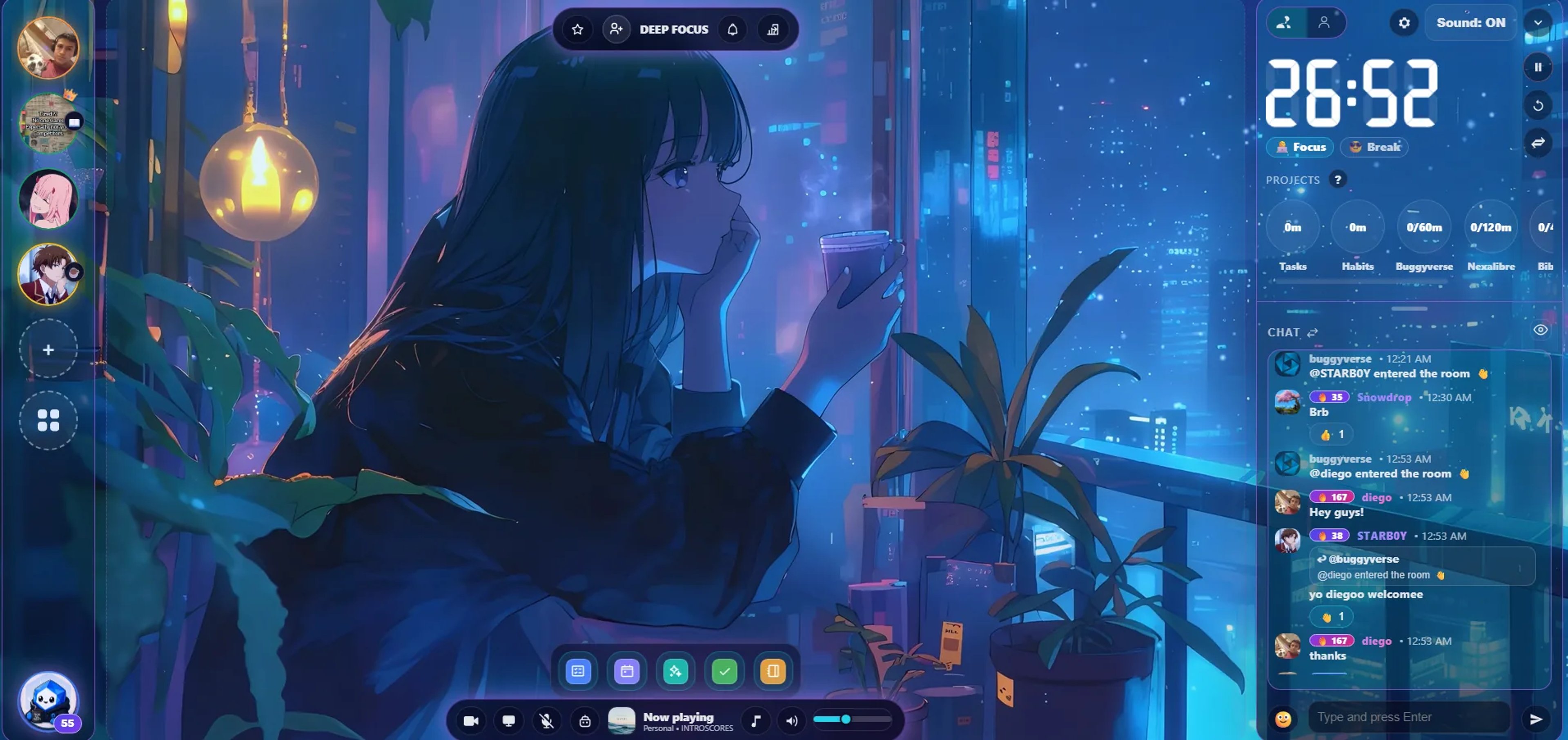
Buggyverse is an online study-room platform built for students, remote learners, developers, and other people who focus better when they are not working alone.
Users can join public rooms or create private ones, study with cameras on or off, use focus timers, chat with room members, and share their screens when useful. The room is intended to be a place people return to, rather than only a one-time call.
What makes it similar to Studyverse
- User-created public and private rooms
- Live presence from other students
- Built-in focus timers
- Optional social interaction
- A room-based experience rather than a purely personal dashboard
Strengths
- Core study-room access is free
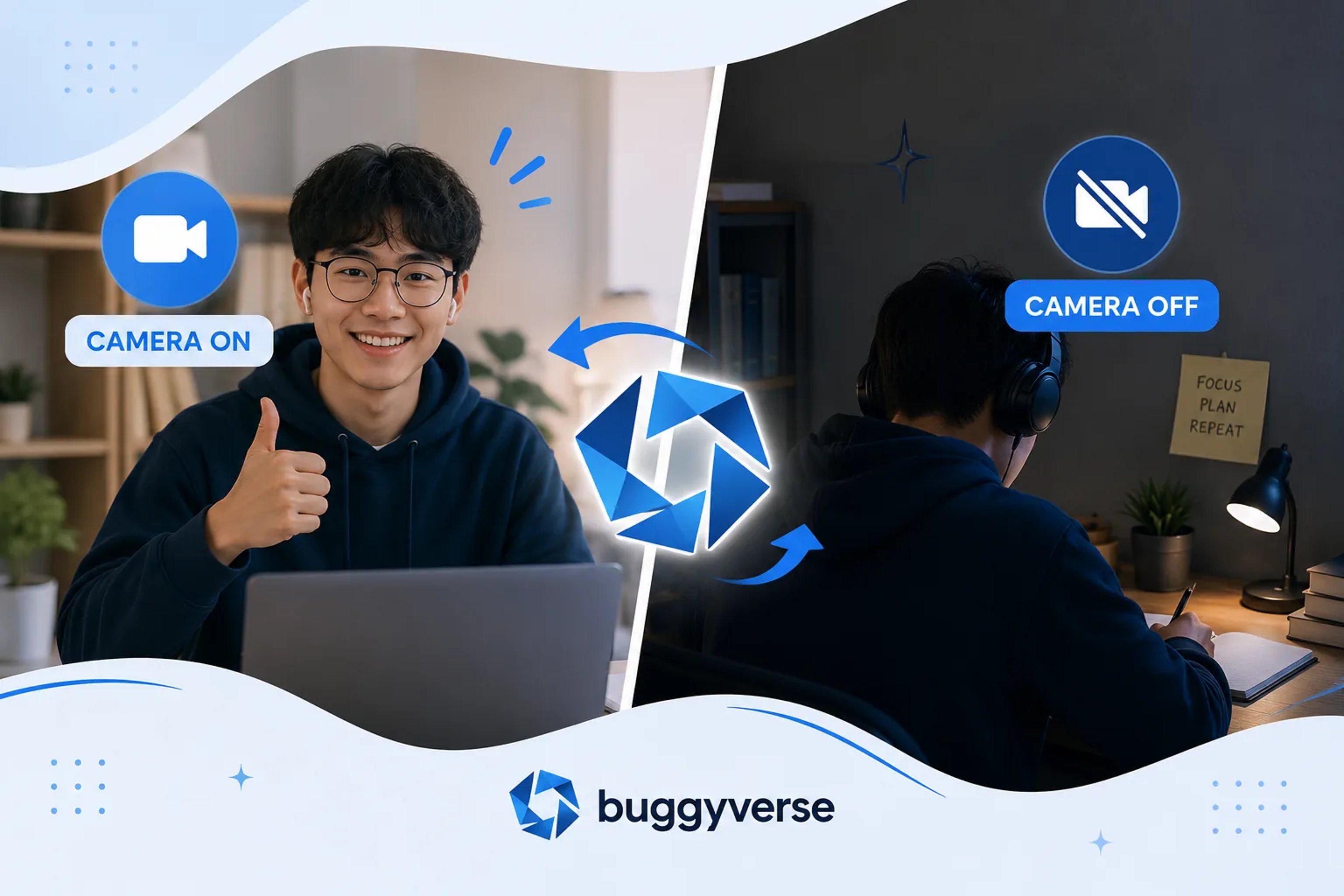
- Cameras are optional rather than mandatory
- Supports room chat and screen sharing
- Smaller rooms can make it easier to recognize recurring members
- Designed around both accountability and reducing online-study loneliness
Limitations
- Buggyverse is newer and smaller than StudyStream
- Activity varies by room and time of day
- It does not currently offer the same depth of aesthetic background customization that made Studyverse distinctive
Choose Buggyverse if: what you miss most is joining a real room, seeing other people present, keeping your camera optional, and returning to a community without paying for basic room access.
2. StudyStream
Best for: large 24/7 focus rooms with immediate activity
StudyStream is one of the largest online study-room platforms. Its main focus rooms run around the clock and regularly contain hundreds of students working silently beside one another.
What makes it similar to Studyverse
- Live students studying together online
- Shared focus rooms
- Pomodoro and productivity features
- A global student community
- Fast entry into an active study environment
Strengths
- It is unlikely that you will enter an empty main room
- Rooms are available across time zones
- Strongest option for the feeling of a crowded digital library
- Established mobile applications and a large community
Limitations
- The largest rooms can feel impersonal
- Students who want small recurring groups may struggle to form closer connections
- Current free access is limited to one hour per day, with unlimited access requiring Premium
Choose StudyStream if: your highest priority is entering a highly active room immediately, even if the experience feels more like a large public library than a small community.
3. LifeAt
Best for: virtual ambience, planning tools, and shared coworking spaces
LifeAt combines immersive digital environments with Pomodoro timers, tasks, calendars, notes, music, soundscapes, and coworking rooms.
Its shared spaces support synchronized ambient environments, group Pomodoro sessions, chat, and video. That makes it one of the strongest replacements for people who cared as much about the atmosphere of Studyverse as the presence of other people.
What makes it similar to Studyverse
- Visual virtual environments
- Ambient sounds and music
- Built-in Pomodoro tools
- Public and invite-based coworking
- Chat and video communication
Strengths
- Strongest aesthetic and ambience-focused option in this list
- Combines focus tools and personal planning in one workspace
- Supports both solo use and shared coworking
- Useful for students who want a visually calming environment
Limitations
- The number of tools can feel overwhelming if you only want a simple room
- Live accountability is not as central as it is on StudyStream, Buggyverse, or Focusmate
- Some features and limits depend on the selected plan
Choose LifeAt if: Studyverse’s customizable atmosphere, sound, and visual spaces were more important to you than entering a large camera-based room.
4. Focusmate
Best for: scheduled one-to-one accountability
Focusmate matches you with one other person for a scheduled focus session. At the beginning, both people state what they intend to accomplish. They then work quietly on camera and check in again at the end.
What makes it similar to Studyverse
- Real human presence during focus sessions
- Body-doubling accountability
- Clear session start and finish
- Works for studying, writing, administration, and remote work
Strengths
- One-to-one matching creates strong social commitment
- Scheduled sessions help people who struggle to begin
- The free plan includes three sessions each week
- Simple format with little room for distracting conversation
Limitations
- Unlimited sessions require a paid plan
- Camera participation is central to the experience
- It does not recreate themed public rooms or an open community space
Choose Focusmate if: Studyverse helped mainly because another real person made you feel responsible for showing up and completing the session.
5. Flocus
Best for: aesthetic solo focus, Pomodoro timers, and personal productivity tools
Flocus is a browser-based productivity dashboard with customizable timers, tasks, themes, music, ambient sounds, and focus statistics.
It is not a live study-room community, but it can replace the solo side of Studyverse for people who mainly used the platform to create a comfortable visual environment and structure their study blocks.
What makes it similar to Studyverse
- Aesthetic visual themes
- Customizable Pomodoro sessions
- Ambient and focus sounds
- Tasks and progress tracking
- A browser-based workspace that is quick to open
Strengths
- Polished and highly customizable solo dashboard
- Free Pomodoro timer available without registration
- Useful combination of timer, sounds, tasks, and statistics
- Less socially distracting than a live community room
Limitations
- No live study partners
- No reciprocal accountability
- Some advanced features require a paid plan
Choose Flocus if: you miss Studyverse’s timer, atmosphere, and personal workspace more than its social rooms.
6. CSW Live
Best for: themed browser rooms that aim to resemble the original Studyverse experience
CSW Live directly presents itself as a Studyverse replacement. It offers browser-based study rooms, themed ambient spaces, timers, and live studying with other people.
Community discussions from the period when Studyverse closed also show former users moving to CSW, making it one of the most directly connected alternatives historically.
What makes it similar to Studyverse
- Themed shared rooms
- Live studying with other users
- Browser access
- Timers and ambient environments
- A product explicitly designed to replace discontinued virtual study spaces
Strengths
- Closer to the themed-room concept than many general productivity apps
- Advertises free, unlimited study-room access
- Low-friction browser experience
- Useful for former Studyverse users who prioritize familiarity
Limitations
- Its current room activity may vary, so check whether the spaces you prefer are active
- Its community and mobile presence are less established than StudyStream’s
- Some claims on its own comparison pages are promotional and should be evaluated through direct use
Choose CSW Live if: you want the closest conceptual replacement for themed, browser-based Studyverse rooms and prefer free access.
7. Discord Study Communities
Best for: flexible study groups and communities built around a subject or shared goal
Discord is not a dedicated study-room platform, but its servers can include text channels, voice rooms, video, screen sharing, roles, events, and moderation tools. Many student communities use those features to run silent rooms, Pomodoro sessions, exam groups, and accountability challenges.
What makes it similar to Studyverse
- Persistent communities and recurring members
- Voice and optional video rooms
- Screen sharing and text chat
- Public or private spaces
- Rooms organized around interests, courses, or exams
Strengths
- Highly flexible and widely available
- Good for existing classmates, university organizations, and subject groups
- Bots can add timers, reminders, roles, and accountability systems
- Strongest option for community ownership and custom organization
Limitations
- Notifications, general chat, and unrelated channels can become distracting
- The quality of the experience depends heavily on moderators
- It requires more setup than a purpose-built online study room
- Finding a safe, active, and well-run server can take time
Choose Discord if: you already have people to study with or want a persistent community organized around a school, exam, subject, or language.
Which Studyverse Alternative Is the Closest Match?
There is no exact replacement, but these are the closest matches by use case:
- Closest for live rooms and community: Buggyverse or StudyStream.
- Closest for themed environments and ambience: LifeAt or CSW Live.
- Closest for direct human accountability: Focusmate.
- Closest for solo timers and aesthetic productivity: Flocus.
- Closest for user-controlled communities: Discord.
Former Studyverse users may also benefit from combining two tools. For example, you could use Flocus or LifeAt for personal planning and ambience, then join Buggyverse or Focusmate when you need stronger human accountability.
Why Buggyverse Stands Out
Buggyverse does not currently recreate every aesthetic feature of Studyverse, and it does not have StudyStream’s scale. Its strongest position is different: it keeps the core room experience free while giving users more control over how socially visible they want to be.
You can enter a public room, create a private room, leave your camera off, use focus tools, interact through chat, or share your screen when collaboration is useful. Smaller rooms also create a better chance of recognizing people you have studied beside before.
That makes Buggyverse especially relevant to former Studyverse users who are not merely searching for another timer. They want a place where studying feels shared without requiring them to perform for a massive public audience.
Buggyverse is not automatically the right choice for everyone. Choose StudyStream when maximum room activity is your priority. Choose LifeAt when ambience is the priority. Choose Focusmate when you need a scheduled partner. Choose Buggyverse when you want free room access, optional cameras, and a smaller community-oriented environment.
How to Move From Studyverse to a New Study Platform
- Identify what Studyverse was doing for you. Was it atmosphere, live people, a timer, a recurring room, or all four?
- Test two alternatives instead of seven. Choose one social option and one solo option based on the guide above.
- Use the same study schedule for one week. A platform cannot help if every session happens at a different time.
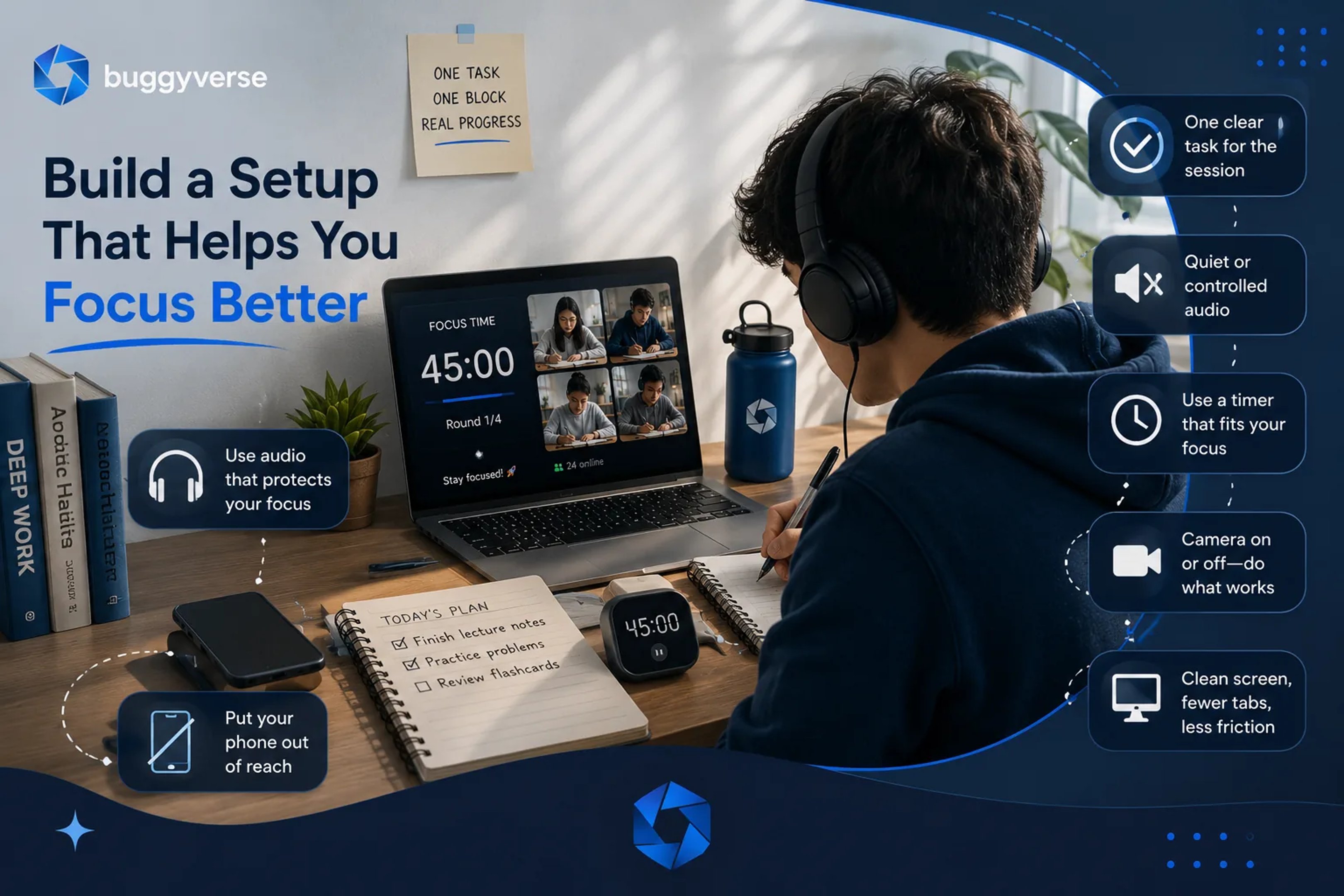
- Begin each session with one visible objective. Write down exactly what you intend to finish before starting the timer.
- Pay attention to whether you return. The best platform is not the one that feels impressive for ten minutes. It is the one you reopen tomorrow.
- Keep the social layer controlled. Turn off unnecessary notifications and leave rooms where conversation consistently replaces studying.
For more help choosing among platforms, see our guide to the best online study room websites.
Frequently Asked Questions
Is the original Studyverse coming back?
There is no confirmed indication that the original Studyverse.live virtual study hall is returning. New websites using similar names should not be assumed to be connected to the original platform.
What is the best free Studyverse alternative?
Buggyverse is the strongest free option for community-focused public and private rooms with optional cameras. CSW Live also advertises free themed rooms. Discord can be free as well, but requires more setup and community management.
What is the closest alternative to Studyverse?
LifeAt and CSW Live are closest to the aesthetic and themed-space side of Studyverse. Buggyverse and StudyStream are closer to its live social-accountability side.
Is Buggyverse free?
Yes. Core access to Buggyverse study rooms is free.
Do I need to turn my camera on in Buggyverse?
No. Camera use is optional, so you can choose the level of visibility that helps you focus without making you uncomfortable.
Is StudyStream free?
StudyStream currently offers one hour of free room access per day. Unlimited use requires its Premium subscription.
Which option is best for people who do not want a camera?
Buggyverse supports camera-optional rooms. LifeAt and Discord can also be used without keeping your camera on, while Flocus is entirely solo. Focusmate is less suitable because video participation is central to its accountability format.
Final Verdict
Studyverse was difficult to replace because it combined virtual atmosphere, focus tools, live people, and user-created spaces in one product. The alternatives available in 2026 divide those strengths in different ways.
Choose StudyStream for maximum live activity, LifeAt for visual ambience, Focusmate for one-to-one accountability, Flocus for solo productivity, CSW Live for themed browser rooms, or Discord for self-managed communities.
Choose Buggyverse when what you want most is a free, community-focused study room where cameras are optional and people can return to the same spaces instead of studying alone.