
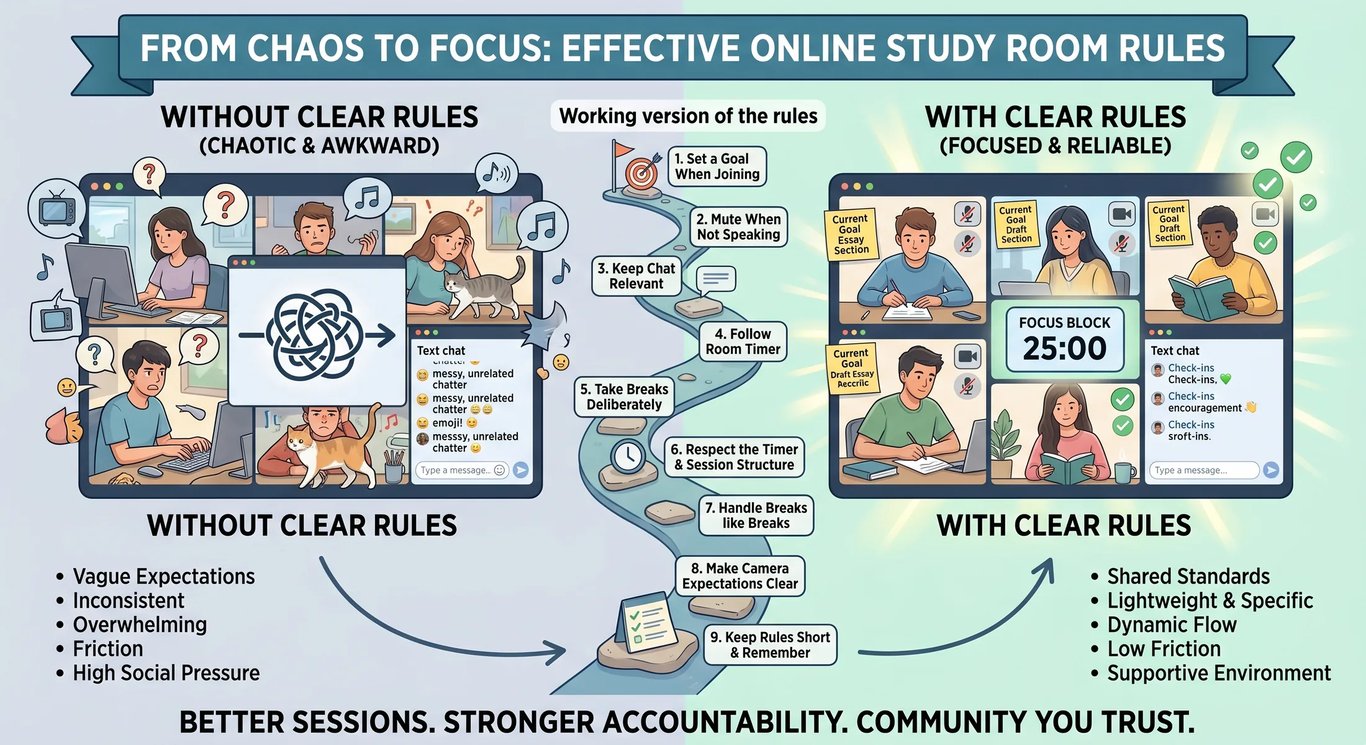
Good study room rules should make focus easier, not make the room feel stiff or over-policed. The best rules are simple, visible, and easy to follow under real conditions, especially when students are tired, stressed, or juggling multiple deadlines.
If your online study room feels chaotic, awkward, or inconsistent, the problem usually is not motivation alone. It is often the absence of shared expectations. Clear rules reduce friction. They help people enter the room faster, stay on task longer, and know what to do when something goes wrong.
In this guide, we will break down the study room rules that actually work, why they work, and how to apply them without turning your space into a punishment box.
What makes a study room rule effective?
A useful rule has four traits:
- It is specific. People know exactly what the rule means.
- It is lightweight. It does not require constant moderation.
- It protects focus. The rule exists for a practical reason, not for appearances.
- It is consistent. Everyone can expect the same standard.
Rules fail when they are vague, too numerous, or disconnected from the room’s real purpose. If a rule does not improve concentration, accountability, or basic respect, it probably does not need to exist.
Rule 1: Arrive with a clear intention
One of the best habits in any study room is starting with a simple goal. Before a session begins, each member should know what they plan to work on. That can be as small as “finish two calculus problems” or as big as “draft the first section of my history essay.”
This matters because vague effort usually produces vague results. A clear intention creates a psychological start line. It also makes accountability easier because people can compare what they planned against what they actually did.
Working version of the rule: When you join, set a specific task or outcome for the session.
Rule 2: Keep distractions off-screen and off-audio
Most focus rooms break down for ordinary reasons: background television, side conversations, loud typing on an open mic, or constant app switching. A good study room protects attention by reducing avoidable noise and visual distraction.
That does not mean every room must be silent or camera-on. It means participants should avoid introducing stimuli that pull attention away from the shared purpose.
- Mute your mic when you are not speaking.
- Do not play music into the room unless it is a room-wide choice.
- Avoid multitasking on unrelated tabs or devices.
- Keep the visible environment appropriate for a focus space.
Working version of the rule: Do not bring unnecessary noise or distraction into the room.
Rule 3: Respect the timer and session structure
Group focus works better when everyone shares the same rhythm. If the room uses 25 minute sprints, 50 minute deep work blocks, or another timer format, that structure should be treated as real. Constantly breaking the cycle weakens momentum for everyone.
The timer is not about control. It is about creating a predictable container for effort. When students trust the rhythm, they settle in faster and resist the urge to drift.
Working version of the rule: Follow the room’s focus and break timing unless there is a clear reason not to.
Rule 4: Use chat with purpose
Chat can help or hurt. A room chat is useful for check-ins, quick encouragement, clarifying session plans, or asking a short question during a break. It becomes a problem when it turns into a second social feed.
If every work block includes random chatter, memes, or unrelated side discussions, the room starts training distraction instead of focus.
Working version of the rule: Keep chat relevant during focus blocks, save casual conversation for breaks or designated social spaces.
Rule 5: Be accountable without being invasive
Some students want strict accountability. Others want lighter structure. The best study rooms balance both by encouraging visible commitment without forcing performative productivity.
For example, it helps to let people post their goal at the start of a session and share a short result at the end. That creates accountability. But demanding constant updates, monitoring every movement, or calling people out publicly for every slip usually backfires.
People stay longer in rooms where they feel supported, not watched.
Working version of the rule: Encourage check-ins and follow-through, but do not turn accountability into surveillance.
Rule 6: Handle breaks like breaks
Breaks are part of focus, not a failure of it. But they need boundaries. A five or ten minute break should let people reset without dissolving the room’s momentum.
Useful break rules include returning on time, avoiding activities that are hard to disengage from, and keeping the restart smooth. If every break becomes an open-ended scroll session, the room pays for it when the next block starts.
Working version of the rule: Take breaks deliberately, then come back when the next session starts.
Rule 7: Keep the room respectful and low-drama
No productivity system survives unnecessary tension. Students need a room where they can concentrate without worrying about sarcasm, mockery, flirt pressure, arguments, or passive-aggressive behavior.
Respect is not a soft extra. It is operational. When the social environment feels calm and safe, people return. When it feels weird, people disappear.
- Do not shame people for struggling.
- Do not pressure others into conversation.
- Do not derail the room with conflict.
- Assume good intent, then escalate only when needed.
Working version of the rule: Protect a calm, respectful environment so people can focus without social friction.
Rule 8: Make camera expectations clear
Camera policy is one of the fastest ways to create confusion. Some rooms require cameras for body doubling. Others allow camera-off study for privacy, bandwidth, or comfort. Either model can work, but ambiguity causes friction.
If cameras are optional, say so clearly. If they are encouraged, explain why. If they are required in certain rooms, label those rooms in advance so people can choose the right environment.
Working version of the rule: Set a clear camera expectation and match it to the room’s purpose.
Rule 9: Keep the rules short enough to remember
Too many rules create compliance theater. People stop reading, moderators get inconsistent, and the room loses credibility. In practice, most study rooms only need a short core list:
- Come in with a goal.
- Respect the timer.
- Limit distractions.
- Use chat appropriately.
- Be respectful.
Everything else can be a guideline or room-specific note. If your rule set cannot fit on one screen, it is probably too long.
How to introduce rules without killing the vibe
A lot of communities make the mistake of writing good rules in a bad tone. Rules should feel steady, not hostile. You are setting a standard, not picking a fight.
Use language that is direct and human. Explain the purpose behind the rule where needed. Keep moderation predictable. When members understand that the rules exist to protect everyone’s focus, buy-in gets much easier.
Good framing sounds like this:
- “Keep chat focused during work blocks so everyone can stay in flow.”
- “Mute when not speaking to keep the room calm.”
- “Set your goal when you join so you leave with a clear win.”
Bad framing usually sounds aggressive, suspicious, or exhausting. That tone invites resistance, even when the rule itself is reasonable.
A simple study room rules template
If you want a practical starting point, use this template:
- Set a goal when you join.
- Follow the room timer.
- Mute when not speaking.
- Keep chat relevant during focus sessions.
- Respect other members and the space.
- Return from breaks on time.
That is enough for most online study rooms. You can add room-specific details later, but the fundamentals should stay simple.
Why these rules matter for long-term consistency
The goal of a study room is not just one productive afternoon. It is repeatable focus. Students come back when the room feels reliable. Reliable rooms are built on shared norms that reduce stress, uncertainty, and distraction.
That is why the best rules often look ordinary. They are not flashy. They just work. Over time, those basic norms create better sessions, stronger accountability, and a community people trust.
Final takeaway
Study room rules that actually work are simple, practical, and aligned with the real goal of the room: helping people focus together. If a rule reduces noise, clarifies expectations, strengthens accountability, or protects respect, it is doing useful work.
If a rule exists only to look strict, it will probably fail.
The strongest online study rooms are not the ones with the longest rule lists. They are the ones with the clearest standards, the calmest environment, and the easiest path back into focused work.