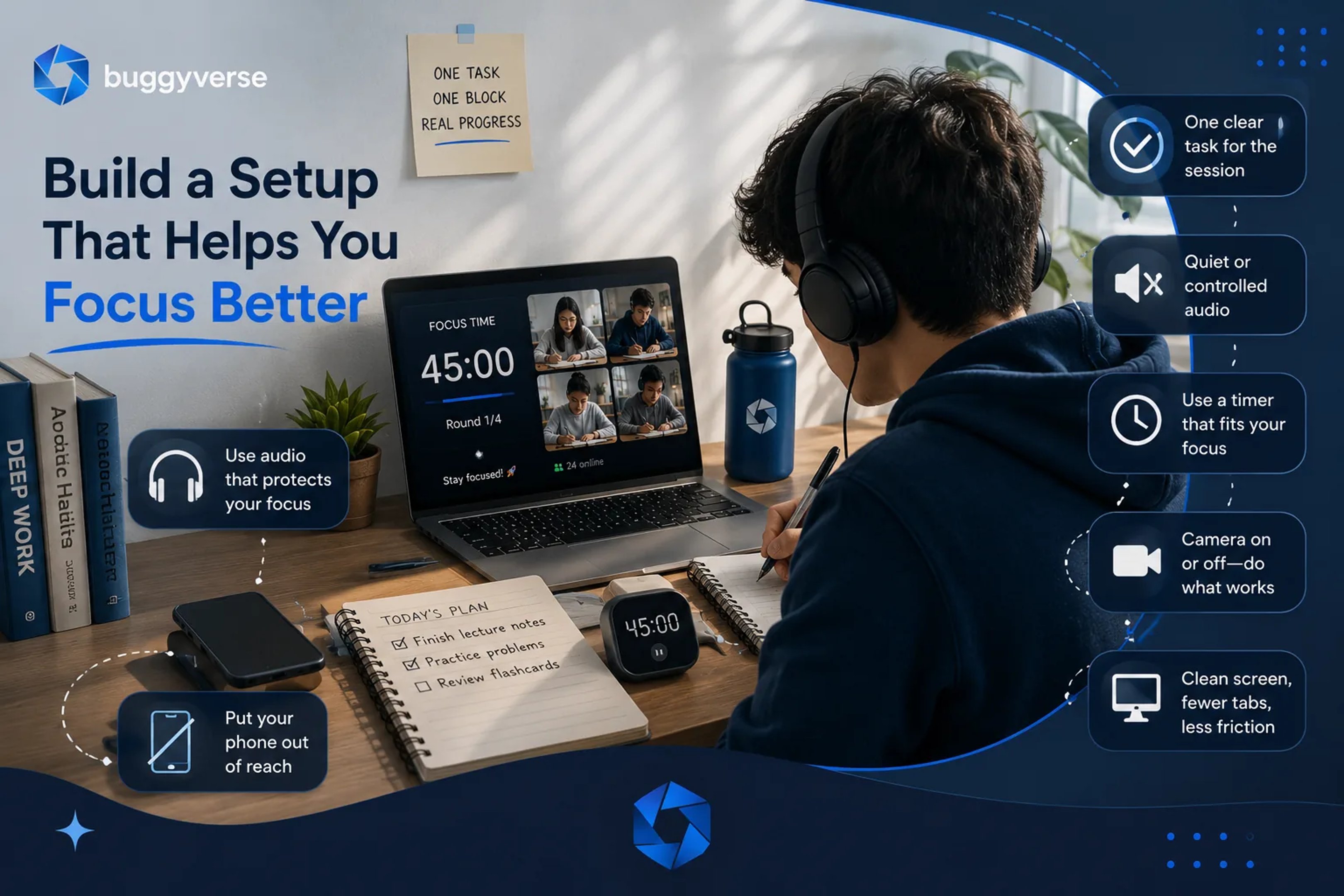

How to Stay Accountable in Online Study Rooms
You have probably experienced this before: you sit down to study, open your laptop, and thirty minutes later you are scrolling through social media. It happens to everyone. The difference between students who stay on track and those who do not often comes down to one thing: accountability.
Online study rooms like Buggyverse give you a built-in accountability system. But just showing up is not enough. Here is how to make it actually work.
Why Accountability Matters for Studying
Research consistently shows that people perform better when someone else is watching. A study published in the Journal of Personality and Social Psychology found that the mere presence of others increases effort on simple tasks. When you study in a room with other focused people, you tap into this effect naturally.
Accountability creates three things:
1. Social pressure — You are less likely to slack off when others can see you.
2. Commitment consistency — Once you say you are going to do something, you want to follow through.
3. Shared momentum — When everyone around you is working, it feels wrong to stop.
Set Clear Intentions Before You Start
Walking into a study room without a plan is like walking into a gym without knowing what you are training. You will waste time figuring out what to do instead of doing it.
Before you join a room:
- Write down your top 3 tasks. Not a wish list. Three concrete things you will finish.
- Set a time block. Decide if you are doing 25 minutes, 50 minutes, or 90 minutes. Commit to it.
- Pick the right room. If you need deep focus, join a silent room. If you need motivation, join an active room with cameras on.
Buggyverse lets you add tasks directly inside the room and track them with a built-in timer. Use both. The act of writing down what you plan to do makes you significantly more likely to do it.
Use the Timer as a Commitment Device
The Pomodoro technique is not just about time management. It is an accountability contract with yourself. When you start a 25-minute timer in a group room, everyone sees it. That visible commitment makes it harder to quietly quit.
How to use timers for accountability:
- Start the group timer. Do not just use a personal timer. When you start the group timer, others join in, and you are all locked in together.
- Respect the break. When the break timer starts, actually step away. Coming back on time shows consistency.
- Stack sessions. Do not stop at one Pomodoro. Plan for 3-4 in a row. The streak builds momentum.
Turn Your Camera On
This is the single most powerful accountability tool in an online study room. When your camera is on, you are visible. You are real. You cannot hide.
Students who study with cameras on report:
- Longer study sessions
- Fewer distractions
- A stronger sense of community
You do not need to be perfectly dressed or have a spotless desk. Just being on camera is enough. Buggyverse rooms support camera feeds so everyone can see who is working alongside them.
Build a Regular Schedule
Accountability works best when it is predictable. If you show up to the same room at the same time every day, you start building relationships with the other regulars. They notice when you are not there. That social expectation is powerful.
Try this structure:
- Morning block (9-11 AM): Deep focus work in a silent room.
- Afternoon block (2-4 PM): Active study with a group room and timer.
- Evening review (8-9 PM): Light review session in a casual room.
Consistency beats intensity. Studying for 2 focused hours every day beats one 8-hour marathon once a week.
Use the Planning AI Tool
Buggyverse has an AI planning feature that helps you break down tasks and organize your week. Use it to:
- Break large assignments into smaller chunks
- Assign tasks to specific days
- Get suggestions based on deadlines and difficulty level
When your plan is generated and visible in the room, you have a second layer of accountability. It is not just you deciding what to do. It is a structured plan that you committed to.
Find an Accountability Partner
If you study in the same rooms regularly, you will start seeing the same people. Reach out. Use the room chat or direct messages to introduce yourself and set up a mutual accountability system:
- Check in at the start of each session with your goals
- Check out at the end with what you accomplished
- Call each other out (kindly) when someone is slacking
You do not need a formal arrangement. Just knowing someone is paying attention to your work changes how you approach it.
Track Your Streaks
Buggyverse tracks your study streaks. Use them as motivation. A streak is a visual representation of consistency, and breaking a long streak feels bad enough to keep you going on days when you want to skip.
Tips for maintaining streaks:
- Start small. A 30-minute session counts. Do not skip days because you cannot do a full session.
- Never miss twice. One missed day happens. Two missed days becomes a habit.
- Celebrate milestones. Hit 7 days, 14 days, 30 days. Acknowledge the progress.
Common Mistakes to Avoid
Joining too many rooms. Pick 1-2 rooms where you are a regular. Spreading yourself across 5 rooms means you are not building real connections anywhere.
Not using the timer. Studying without a timer in a study room is like going to the gym and not lifting anything. You are there, but you are not using the tools.
Being passive. Accountability requires participation. Say hi in chat. Start the timer. Turn on your camera. The more you put in, the more you get back.
Comparing yourself to others. Someone studying 6 hours does not mean your 2 hours are worthless. Focus on your own consistency and improvement.
The Bottom Line
Accountability in online study rooms is not complicated. It comes down to:
1. Showing up consistently
2. Setting clear intentions
3. Using the tools available (timer, camera, tasks, planning)
4. Building relationships with other students
Start with one change today. Turn on your camera. Start the group timer. Write down your tasks. Small actions compound into real results over time.
The room is already there. The tools are built in. The only thing missing is you, actually using them.