
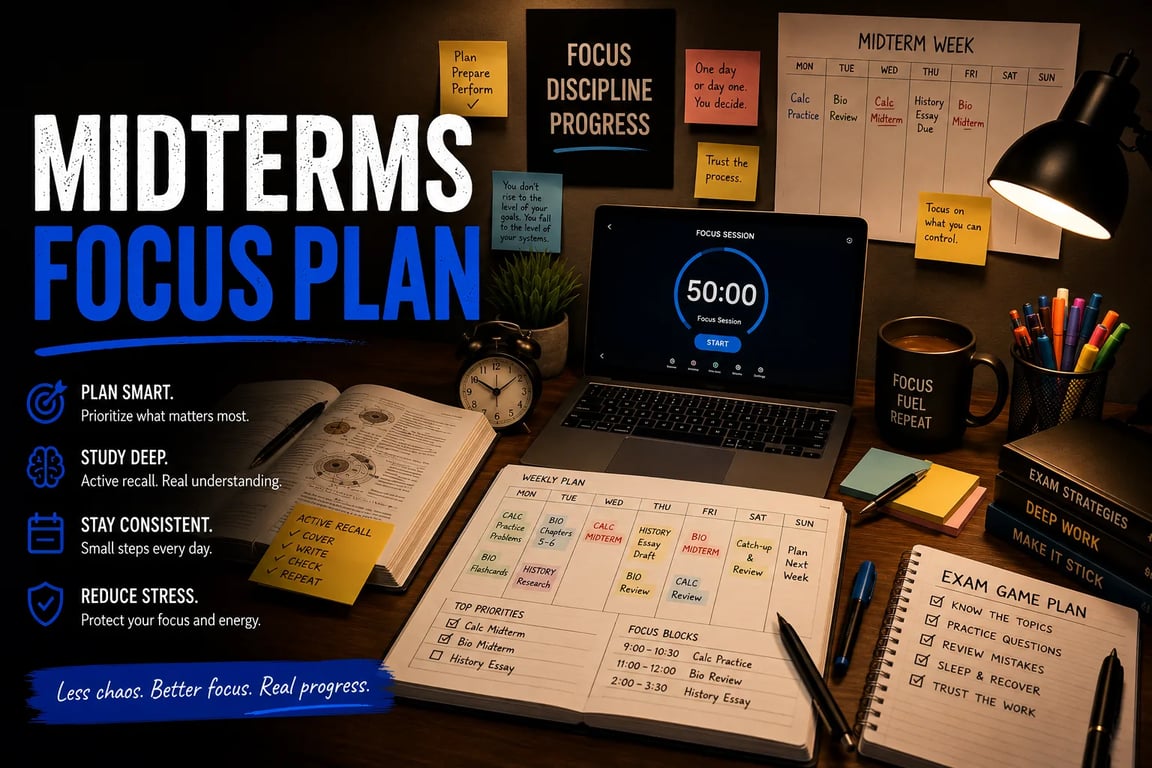
Midterms go wrong for a predictable reason. Most students do not fail because they do not care. They fail because the work arrives all at once, stress rises fast, and their study plan becomes reactive instead of structured.
A good midterms focus plan does not try to make you feel perfect. It gives you a system you can trust when your brain is noisy, your deadlines are stacked, and every class feels urgent at the same time.
If you are preparing for multiple exams, papers, or projects in the same week, this guide will help you build a realistic plan that protects your energy, improves retention, and makes each study session clearer from the moment you sit down.
What a midterms focus plan should actually do
A strong plan should do four things:
- Clarify priorities. You should know what matters most this week.
- Reduce decision fatigue. You should not waste half your study time deciding what to do.
- Create repetition. Important material should come up more than once.
- Protect consistency. Your plan should be sustainable for several days, not just one heroic night.
That means your goal is not to make the most ambitious schedule possible. Your goal is to make a plan you can actually execute under pressure.
Step 1: List every midterm demand in one place
Before you build time blocks, you need one clean overview. Open a note, document, or planner and write down each course with the exact work attached to it.
- Exam date
- Format, such as multiple choice, essays, problem solving, or open note
- Topics covered
- Assignments still due before the exam
- Your current confidence level
This matters because stress gets worse when tasks stay vague. A full list turns a foggy threat into a visible workload.
Example:
- Biology: Midterm Friday, chapters 5 to 8, low confidence in cellular respiration
- Calculus: Midterm Wednesday, integration techniques, medium confidence
- History: Essay due Thursday, research mostly done, draft incomplete
Step 2: Rank by urgency and difficulty
Not all tasks deserve equal attention. Students often overstudy what feels comfortable and avoid what is harder. A better move is to rank each subject using two questions:
- How soon is it due?
- How weak am I in this material right now?
When a subject is both near and difficult, it should move up the list quickly. When a task is far away and already manageable, it can get shorter maintenance sessions.
A simple 3-tier ranking works well:
- Priority A: soon and weak
- Priority B: soon or weak
- Priority C: later and stable
This ranking prevents random studying. It gives your week a command structure.
Step 3: Break each subject into study targets
“Study chemistry” is not a usable task. “Review chapter 4 reactions, solve 12 practice questions, then correct mistakes” is usable.
Break each course into targets that fit inside one focus block. Good targets usually look like this:
- Review lecture slides for one unit
- Create flashcards for one chapter
- Complete one practice set
- Rewrite one outline from memory
- Draft one essay section
Smaller targets matter because they create visible wins. Under midterm pressure, momentum is a resource. Specific tasks make starting easier and finishing more satisfying.
Step 4: Build your week around focus blocks, not vague intentions
Now turn those targets into scheduled work. Do not just write “study Tuesday evening.” Assign real blocks with a job.
A basic framework that works well for midterms is:
- Short block: 25 to 30 minutes for light review or restart sessions
- Standard block: 45 to 60 minutes for most studying
- Deep block: 75 to 90 minutes for problem solving, essay drafting, or hard review
For many students, two or three solid blocks per day is more reliable than trying to claim eight perfect hours.
Sample weekday plan:
- 4:30 PM to 5:20 PM, calculus practice set
- 5:30 PM to 6:20 PM, biology chapter review
- 7:30 PM to 8:20 PM, history essay draft revision
Each block should answer one question clearly: what am I doing in this session?
Step 5: Put your hardest subject earlier than your motivation tells you to
Most students instinctively warm up with easier tasks. That can help at times, but during midterms it often becomes disguised avoidance. Your hardest or highest-priority subject usually deserves one of your earliest and best blocks.
If you leave the hardest work for the end of the night, you are forcing your most difficult thinking into your lowest-energy window.
A better pattern is:
- Start with your highest-value block
- Use later blocks for review, repetition, or lighter admin work
- Save low-cognition tasks for low-energy periods
This is not about discipline theater. It is simple energy management.
Step 6: Use active recall instead of passive rereading
One of the biggest midterm mistakes is spending hours looking at material without forcing retrieval. Passive review feels productive because it is familiar, but it often creates weak memory.
Use more active methods instead:
- Answer questions without looking at notes first
- Rebuild a concept from memory on paper
- Teach the topic out loud in simple language
- Do timed practice problems
- Turn headings into self-quizzes
During exam season, testing yourself is usually more valuable than rereading for the third time.
Step 7: Add one review loop before the exam day
A midterms focus plan should revisit important material at least once after the first exposure. If you study something once and never touch it again before the exam, retention drops fast.
Try this simple loop:
- Day 1: Learn or review the material
- Day 2 or 3: Test yourself on it again
- Day before exam: Do a short high-yield recap
This keeps your study plan from becoming a pile of disconnected first passes.
Step 8: Use online focus rooms to stay consistent
Midterms are exactly when many students lose structure. They sit down intending to study, feel overwhelmed, drift to other tabs, and spend half the night negotiating with themselves.
Online focus rooms can help because they remove isolation and create a visible work rhythm. When you join a room with a timer, a goal, and other students doing the same, starting becomes easier.
That works especially well for:
- Beginning a session when you feel resistance
- Running timed review blocks
- Sticking to a break schedule
- Getting social accountability without a full study group
If you tend to procrastinate when studying alone, body doubling and shared focus structure can make a big difference.
Step 9: Protect sleep and recovery like part of the plan
Students often treat sleep as optional during midterms, then wonder why memory, mood, and concentration collapse. Cutting rest too hard reduces the quality of the very study time you are trying to protect.
Even if your week is intense, keep a few guardrails:
- Avoid all-night cram sessions when possible
- Stop difficult work early enough to wind down
- Eat before long study blocks
- Take short breaks before your brain forces a longer one
Recovery is not separate from performance. It supports it.
Step 10: Prepare a realistic exam-day review
The day of the midterm is not the time for full re-learning. It is the time for short confidence-building review. Your exam-day plan should focus on:
- Key formulas, frameworks, or dates
- Common mistakes you already identified
- One or two representative problems
- A quick scan of your summary sheet or flashcards
Keep it tight. The point is to sharpen recall, not trigger panic.
A simple 5-day midterms focus plan example
Here is a practical example for a student with two exams and one paper due in the same week:
Day 1
- Build task list and rank priorities
- Deep block: calculus weak topics
- Standard block: biology chapter 5 review
- Short block: history essay outline cleanup
Day 2
- Deep block: calculus timed practice
- Standard block: biology flashcards and recall
- Standard block: history body paragraph draft
Day 3
- Short block: calculus error review
- Deep block: biology chapters 6 and 7 active recall
- Standard block: history revision and citations
Day 4
- Exam-day style review for calculus
- Submit history essay
- Standard block: biology practice questions
Day 5
- Short high-yield biology review
- Take exam
- Light recovery block or next-subject planning
This kind of plan works because every block has a purpose and the week has a rhythm.
Common midterms planning mistakes
- Overloading one day. A schedule that is too dense usually collapses by day two.
- Using vague tasks. If the session goal is fuzzy, procrastination gets room to grow.
- Ignoring weak areas. Comfort studying feels good, but it leaves risk untouched.
- Studying without retrieval. Looking at notes is not the same as proving recall.
- Running on panic. Panic may start a session, but it is a poor long-term system.
Final takeaway
A solid midterms focus plan turns exam season from a blur into a sequence of clear actions. You do not need a perfect week. You need a week with priorities, defined study blocks, active review, and enough structure to keep moving when motivation drops.
When you know what to study, when to study it, and how to stay accountable while doing it, midterms stop feeling like one giant emergency and start feeling like a problem you can work through block by block.
That is the real goal of a good plan: less chaos, better focus, and more consistent progress when it counts.