
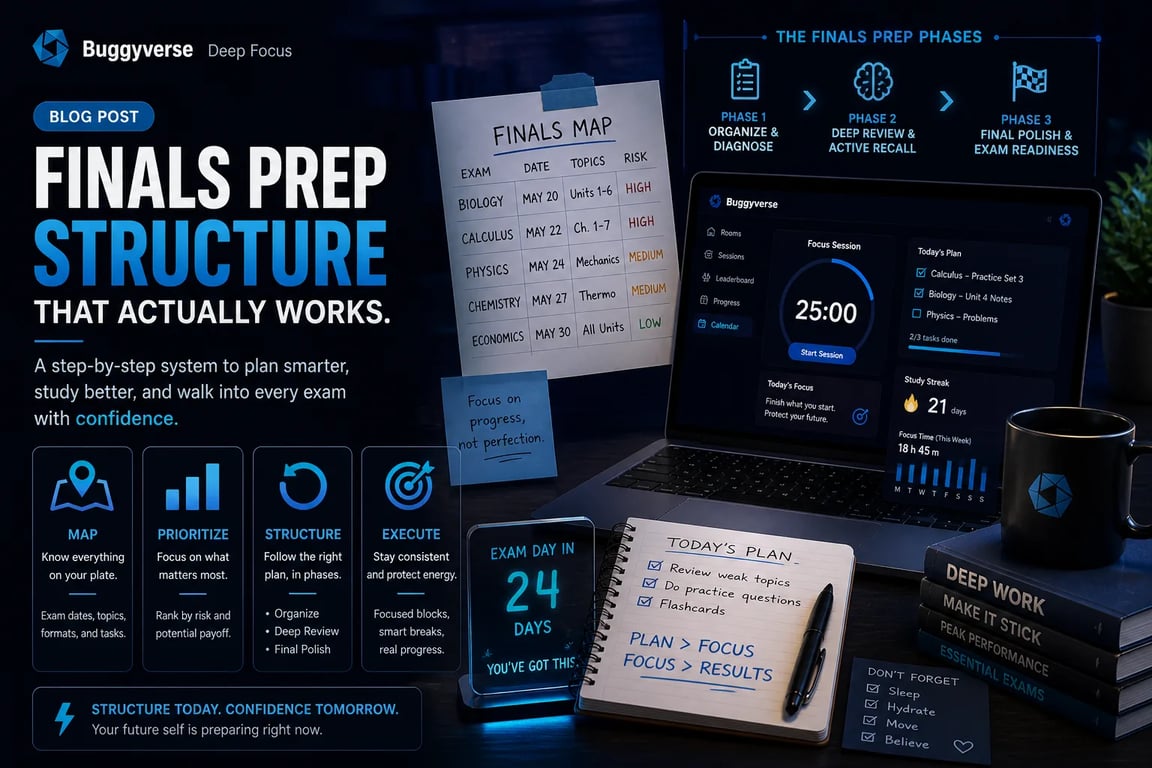
Finals season breaks a lot of students for one simple reason: they try to solve everything at once. Every class feels urgent, every topic feels unfinished, and every hour starts to feel too small for the amount of work left. When that pressure builds, students often react by studying harder in a chaotic way instead of studying in a structured way.
That usually makes things worse. Long, unplanned sessions drain energy. Random review creates false confidence. Panic leads to jumping between subjects without finishing anything important. The problem is not effort alone. The problem is weak structure.
A good finals prep structure gives you a way to decide what matters, when to study it, and how to keep moving without burning out before exam day. The goal is not perfection. The goal is repeatable progress under pressure.
In this guide, we will break down how to build a finals prep structure that is realistic, flexible, and strong enough to carry you through exam season.
Why structure matters more than motivation during finals
Motivation is unstable during high-stress periods. Some days you feel locked in. Other days you feel tired, scattered, or behind before you even start. If your study system depends on feeling inspired, finals week will expose that weakness fast.
Structure helps because it reduces decision fatigue. Instead of waking up and asking, “What should I even do first?” you already know the next action. That clarity protects time and energy. It also reduces the emotional weight of starting.
Students usually perform better in finals when they stop relying on urgency as the main driver and start relying on a system they can follow.
Start with a finals map, not a giant to-do list
Before building study sessions, build a clear map of the exam period. This should include:
- Each exam date and time.
- The format of each exam.
- The major topics or units covered.
- Any assignments, projects, or papers still due.
- Your current confidence level for each course.
This step matters because most students underestimate how much stress comes from uncertainty. Once everything is visible, your brain stops treating all classes as equally mysterious and urgent.
A finals map lets you separate what is truly high priority from what just feels loud.
Rank courses by risk and payoff
Not every class deserves the same attention at the same moment. A strong finals prep structure accounts for both academic risk and potential payoff.
Ask these questions for each course:
- How much does the final affect the course grade?
- How confident am I in the material right now?
- How much content still needs review?
- Is this class memorization-heavy, problem-heavy, or writing-heavy?
From there, sort courses into three rough groups:
- High risk: low confidence, high stakes, large content gaps.
- Medium risk: decent understanding, but still needs structured review.
- Low risk: relatively stable, needs maintenance and light refresh.
This is important because finals prep is not about treating everything equally. It is about putting the best energy where it changes outcomes most.
Use three phases instead of one giant cram period
One of the cleanest ways to structure finals prep is to divide it into phases. This keeps your study behavior aligned with what the moment actually requires.
Phase 1: Organize and diagnose
In this phase, you gather materials, identify weak areas, and set the plan. You are not trying to master everything yet. You are getting honest about where you stand.
- Collect notes, slides, readings, and practice materials.
- List topics by course.
- Mark weak topics clearly.
- Identify what needs active practice versus quick review.
Phase 2: Deep review and active recall
This is where most of the real learning happens. Use focused blocks to revisit concepts, solve problems, rehearse explanations, and close the biggest gaps.
- Use practice questions.
- Write from memory before checking notes.
- Teach concepts out loud in simple language.
- Repeat difficult problem types until the method feels stable.
Phase 3: Final polish and exam readiness
As exams get very close, the job changes. You are no longer trying to learn everything from zero. You are sharpening recall, checking blind spots, and protecting energy.
- Review summary sheets.
- Run timed practice where relevant.
- Revisit the highest-risk topics one last time.
- Reduce overload the night before the exam.
These phases stop you from using the same study method at every stage. That alone can make finals prep feel much more controlled.
Build sessions around subjects, not vague time promises
Students often say things like, “I will study all afternoon.” That sounds serious, but it is too vague to be useful. Better structure comes from assigning a clear job to each session.
For example:
- Bad session plan: study biology for three hours.
- Better session plan: review cellular respiration, complete 15 practice questions, and correct mistakes.
When each session has a defined target, you know when you are making progress. You also reduce the tendency to drift into passive review that feels productive but is not.
Use focused blocks with realistic recovery
Finals prep should feel sustainable, not theatrical. Marathon sessions can happen occasionally, but they should not be the foundation of the plan. Most students do better with repeatable focus blocks that they can maintain over multiple days.
A practical structure might look like this:
- 2 to 4 focused work blocks per day for harder subjects.
- 25 to 50 minutes per block depending on task difficulty and stamina.
- Short breaks between blocks.
- One longer reset break after every few sessions.
If you use online study rooms or virtual coworking sessions, this becomes easier. Shared timers and visible accountability reduce startup friction and help you stay inside the block once you begin.
Match your method to the exam type
A finals prep structure fails when it uses the same review style for every class. Different exam formats demand different work.
For problem-solving exams
Use worked examples, timed problem sets, and error review. Reading solutions is not enough. You need repeated execution.
For writing-heavy exams
Practice outlining arguments, recalling evidence, and answering sample prompts under time pressure. Focus on clear structure, not just content review.
For memorization-heavy exams
Use active recall, flashcards, retrieval drills, and spaced review. Re-reading alone usually creates familiarity without durable recall.
Good structure means aligning the session with the performance the exam will demand.
Create one daily priority list, not five competing ones
During finals, students often carry too many task lists at once. There is the class portal, the notebook list, the mental list, the phone notes, and the guilt list. That split attention creates friction.
Use one daily command list with:
- your top one to three must-do study blocks,
- one backup task for low-energy moments,
- any hard deadlines due that day.
This keeps the day operational. If energy drops, you still know what the next priority is.
Plan your hardest work earlier than your panic tells you to
Many students delay the hardest subjects because they feel intimidating. Then those subjects become emergency work later, when time is shorter and stress is higher. A better finals prep structure attacks high-friction material earlier.
That does not mean doing only the hardest class all day. It means giving difficult or high-risk work protected space before the deadline pressure becomes overwhelming.
If a class scares you, that is often a sign it needs earlier contact, not later avoidance.
Use review loops, not one-time coverage
Seeing a topic once is not the same as retaining it. Finals prep works better when topics reappear in planned loops.
A simple review loop might be:
- Learn or revisit the topic.
- Test yourself without notes.
- Correct errors.
- Return to that topic again a day or two later.
This matters because students often confuse exposure with readiness. Review loops make knowledge more retrievable under exam conditions.
Protect sleep and basic stability
This part is not optional. Finals prep gets weaker when students treat sleep, food, and recovery like disposable extras. Sleep loss hurts recall, focus, judgment, and emotional control, which are exactly the things you need during exams.
You do not need perfect wellness during finals. You do need enough stability to think clearly. A solid structure includes:
- reasonable sleep targets,
- real meals,
- water and movement breaks,
- cutoffs that stop endless low-quality review late at night.
Students often feel guilty resting during finals, but bad recovery turns study time into weaker study time.
A sample finals prep structure for one week
Here is a simple example for a student managing three finals:
- Day 1: build finals map, sort subjects by risk, gather materials.
- Day 2: deep review for highest-risk class, one maintenance block for second class.
- Day 3: practice problems and recall drills for first class, summary review for third class.
- Day 4: timed practice or mock response session, fix error patterns.
- Day 5: rotate through highest-yield topics, focus on weak spots only.
- Day 6: lighter review, memory refresh, exam readiness check.
- Day 7: final touch-up and energy protection before exam day.
The exact schedule will vary, but the principle stays the same: organize first, review deeply, then polish strategically.
How Buggyverse-style focus sessions can help
One reason students lose structure during finals is that studying starts to feel lonely and heavy. Focus rooms help by turning isolated pressure into shared momentum. When you join a room, set a goal, and work through clear blocks with other students, it becomes easier to start and easier to stay in motion.
This does not replace planning. It supports execution. A good finals prep structure tells you what block to do. A good focus environment helps you actually do it.
Final takeaway
The best finals prep structure is not the most intense one. It is the one you can keep following when stress rises. Map the exam period clearly, rank courses by risk, divide your prep into phases, give each session a specific job, and use review loops that strengthen recall instead of just creating familiarity.
Finals season will always carry pressure. But pressure with structure is much more manageable than pressure with chaos.
If you want better results, do not start by promising yourself a heroic week. Start by building a system that makes the next focused study block obvious.